


A furnace that fires up and then shuts off after a few seconds is a common winter complaint. One frequent culprit is the flame sensor, a small part that tells the furnace there really is a flame. This guide explains what it does, what else can cause the same symptom, and why we suggest leaving the repair to a technician.
What the flame sensor does
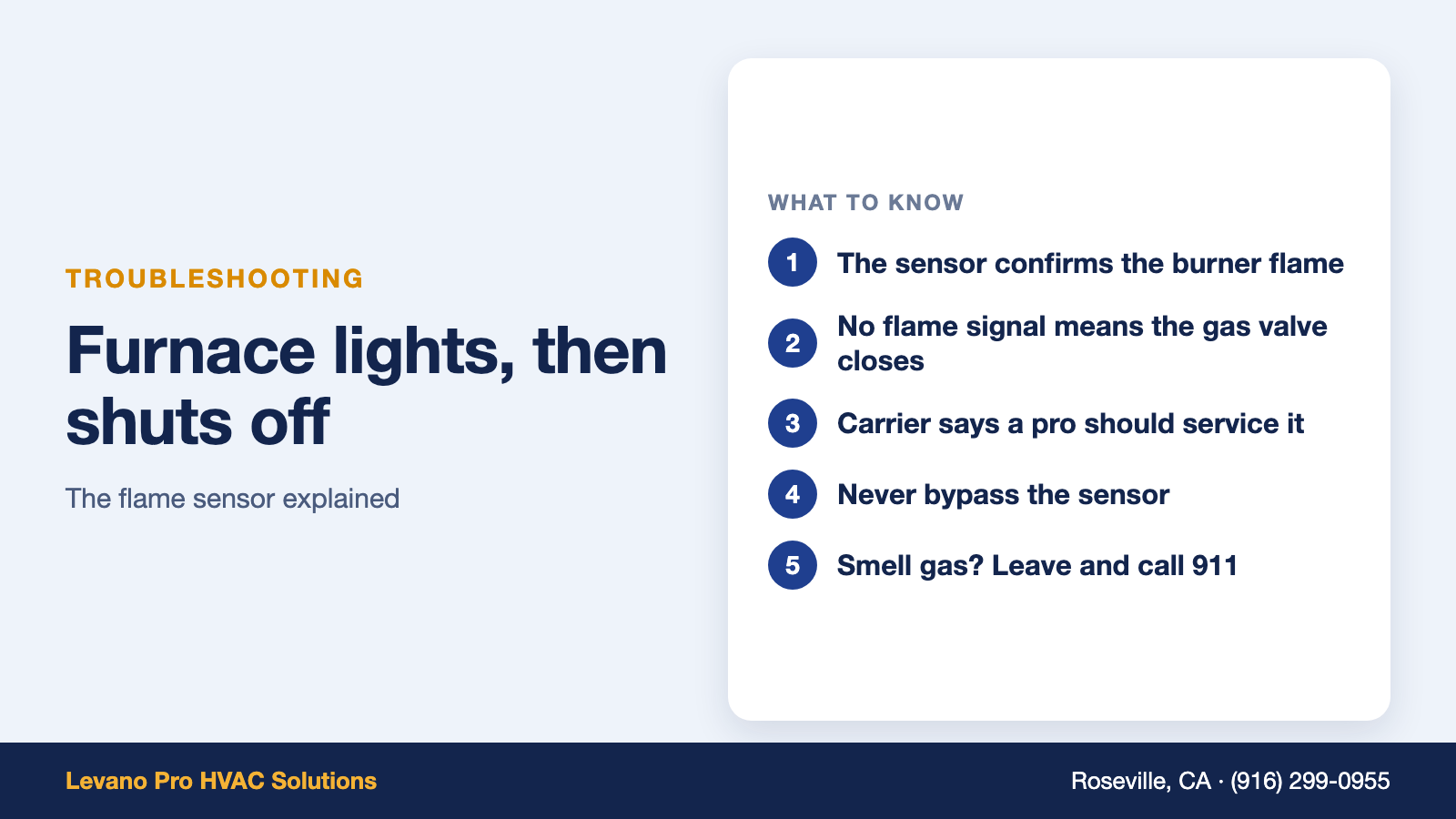
Carrier describes the flame sensor as a metal rod in the burner assembly. It uses a principle called flame rectification to confirm that a flame is present. When the furnace starts, the igniter lights the burners, and the control board waits for the sensor to confirm a flame. If it does not get the signal, the board closes the gas valve. That is a safety feature, because it stops unburned gas from entering the house.
Symptoms
According to Carrier, the usual symptom is that the furnace lights and then shuts off after a few seconds. It lists these related signs:
- Short cycling
- An igniter that glows with no heat afterward
- Fault codes on the control board
- Lockout after several failed attempts
Other ignition, wiring, gas or control problems can look the same. A furnace that lights and shuts off is not proof of a bad flame sensor. See furnace blinking light codes to read what your board is reporting.
Should you clean it yourself
Carrier does not recommend homeowner cleaning. It says the sensor should be maintained by a trained HVAC professional, and warns never to bypass or defeat the sensor. We did not find a manufacturer that gives homeowners cleaning instructions. The risk of getting it wrong includes a furnace that runs without a flame check. Furnaces also carry gas and electrical hazards, so we leave this to technicians.
What you can safely check
- Confirm the thermostat is set to Heat and the setpoint is above room temperature.
- Replace the air filter. A clogged filter can cause the furnace to shut down for safety. See air filter sizes and MERV ratings.
- Look at the flash code on the control board and write it down.
- Confirm the gas shutoff valve is open.
Then call for service. See no heat at night checklist for the full order of checks.
When to call right away
- The furnace keeps locking out
- The flame is yellow or orange instead of blue
- You smell gas. Leave the home, call 911, then your gas utility.
- The control board shows error codes
- You see soot or smell burning
Other causes of the same symptom
- A weak or failing igniter
- A restriction in the gas supply
- A dirty or failing burner assembly
- A control board or wiring fault
- A clogged filter or limit switch problem. See furnace will not turn on.
Repair or replace
A flame sensor is a minor part, and a repair is usually much less than a new furnace. If the furnace is old or has other problems, see furnace repair cost and when to replace a furnace.
We repair furnaces in Roseville, Rocklin, Folsom and Elk Grove. See our heating and furnace services or contact us. We answer emergency calls 24/7, including weekends.
Frequently asked questions
What does a furnace flame sensor do?
It is a thin metal rod in the burner area that confirms there is a flame. Carrier explains that it uses flame rectification to detect the flame. If the control board does not get that signal, it closes the gas valve to stop unburned gas from entering the home.
Why does my furnace light and then shut off?
Carrier says the typical symptom of a failing flame sensor is that the furnace lights, then shuts off after a few seconds. Other ignition, wiring, gas or control problems can look the same, so a technician needs to confirm the cause.
Can I clean the flame sensor myself?
Carrier does not recommend it. It says the sensor should be maintained by a trained HVAC professional, and warns never to bypass or defeat it. We did not find a manufacturer that gives homeowners cleaning instructions.
What other signs point to a flame sensor problem?
Short cycling, an igniter that glows without heat, fault codes on the control board and a furnace that locks out after several tries. These can also come from other causes.
When should I call a professional?
Call if the furnace keeps locking out, the flame is yellow or orange, you smell gas or the control board shows error codes. If you smell gas, leave the home and call 911, then your gas utility.