


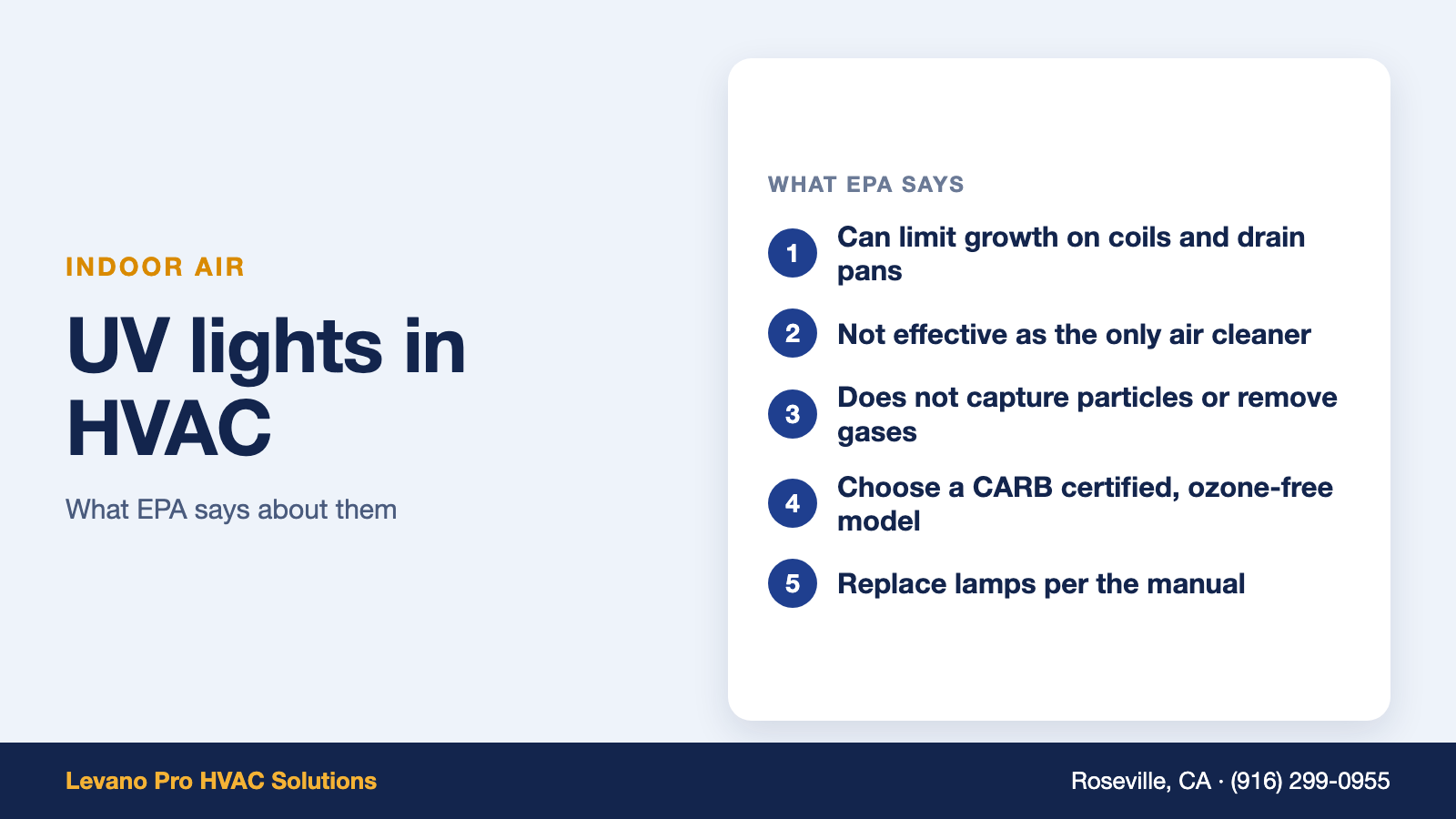
UV lights for HVAC systems are one of the most common upsells in the industry. Some of the claims are exaggerated, but there is a real use for them. The most reliable information comes from the Environmental Protection Agency, which reviewed ultraviolet germicidal irradiation, or UVGI, in its technical summary of residential air cleaners.
The two ways UV is used in homes
- Coil lights. A lamp shines on the cooling coil and drain pan to prevent growth on those surfaces. The lamp usually sits downstream of the filter and upstream of the cooling coil.
- Airstream lights. A lamp in the duct tries to treat the air as it passes.
What EPA says works
EPA says UVGI can be effective for inhibiting biological growth on HVAC cooling coils and drain pans. It destroys growth on exposed surfaces, but not most spores, and it is ineffective inside filter media, crevices or porous insulation. That makes a coil light a reasonable add-on for a system that has a history of coil growth, as long as it is not used instead of good moisture control. EPA notes that drain pans designed to drain and proper dehumidifying remain the primary ways to control microbial growth in an air handler.
What EPA says does not work well
- Cleaning the air in the home. EPA says typical home UV systems do not deliver sufficient doses to effectively kill or deactivate most airborne microorganisms, because exposure time is short or intensity is low. UVGI does not appear to be effective as a sole control device.
- Removing particles. UV does not capture dust, pollen or smoke. It should supplement filtration. With a MERV 13 or higher filter in place, EPA says UVGI offers only minimal infection control benefit.
- Removing gases. EPA found no research showing that UV removes gaseous pollutants.
EPA adds that there is no standard test to rate UVGI effectiveness in residential HVAC, though ASHRAE standards 185.1 and 185.2 cover the testing of airstream and surface UV devices.
Ozone and California rules
Some UV lamps generate ozone. EPA says uncoated UV-C lamps at 254 nanometers and below can produce it, and recommends avoiding air cleaners that intentionally make ozone. In California, portable air cleaners must be CARB certified for ozone and electrical safety, and electronic in-duct air cleaners, which include UV devices, have been covered since October 2020. They must emit no more than 0.050 parts per million of ozone. CARB certification does not measure how well a device cleans. Check the CARB list before you buy.
Maintenance
EPA says maintenance usually consists of cleaning the lamps of dust and replacing old lamps. Intervals vary by product. Resideo’s AirBRIGHT lists a two year first bulb and annual replacement after that, and Aprilaire’s in-duct UVC lists every two years. UV-C is harmful to bare skin and eyes, so turn the system off before you open it and never look at an active lamp.
What it costs
Angi’s cost guide lists whole-house UV air purifiers at roughly $750 to $3,500, and simple coil lights cost less. Prices vary widely by product and by installer. The lamps are a recurring cost.
When a UV light makes sense
- You have had mold or biofilm on the coil or drain pan, and the root moisture problem is fixed.
- You already use a good filter and want an extra measure for the coil.
- You choose a CARB certified, ozone-free model and have it installed by a professional.
What to do instead or first
- Replace the filter on schedule. See air filter sizes and MERV ratings.
- Keep the condensate drain clear and the pan draining.
- Fix leaks and humidity problems at the source.
- Have the coil inspected during maintenance. See what a tune-up includes.
For smoke and dust, filtration is the main tool. Our guide on wildfire smoke and your HVAC filter explains it. We install and service indoor air quality equipment in Roseville, Rocklin, Folsom and Elk Grove. See our HVAC services or contact us.
Frequently asked questions
Do UV lights in an HVAC system kill mold?
EPA says UV germicidal lamps can be effective for inhibiting biological growth on cooling coils and drain pans. They affect growth on exposed surfaces, but they do not remove existing mold from filter media, crevices or porous insulation, and most spores are not killed.
Can a UV light clean the air in my home?
EPA says typical home UV systems do not deliver enough exposure to kill or deactivate most airborne microorganisms, and that UV does not appear to be effective as a sole control device. It does not capture dust or pollen, and no studies were found showing it removes gases.
Do HVAC UV lights make ozone?
Some can. EPA says uncoated UV-C lamps at 254 nanometers and below can generate ozone, and recommends avoiding devices that intentionally produce it. In California, electronic in-duct air cleaners must be CARB certified to emit no more than 0.050 parts per million of ozone.
How often do HVAC UV lamps need replacing?
It depends on the model. Resideo’s AirBRIGHT lists a two year first bulb and annual replacement after that, and Aprilaire’s in-duct UVC lists every two years. Follow the manual for your unit.
Is a UV light a substitute for a good filter?
No. EPA says UV should supplement filtration, not replace it. With a MERV 13 or higher filter in place, UV adds only minimal infection control benefit over the filter alone.