


If you were quoted a refrigerant charge this year and it was higher than you remember, you are not being overcharged. The refrigerant in most American air conditioners is being phased down by federal rule, new equipment has already switched to a different one, and both facts land on your invoice. Here is the plain version.
What actually changed
Under the federal AIM Act, the high global warming potential refrigerants are being stepped down in production. R-410A, the refrigerant in essentially every residential system installed from roughly 2010 onward, is part of that step-down. Manufacturers moved new residential equipment to lower impact refrigerants, principally R-454B, for systems built from 2025.
Two consequences follow, and they are the whole story:
- R-410A is not banned and your system is not illegal. It is still produced and still sold for servicing existing equipment. What is happening is that supply is being reduced on a schedule, which pushes the price up over time.
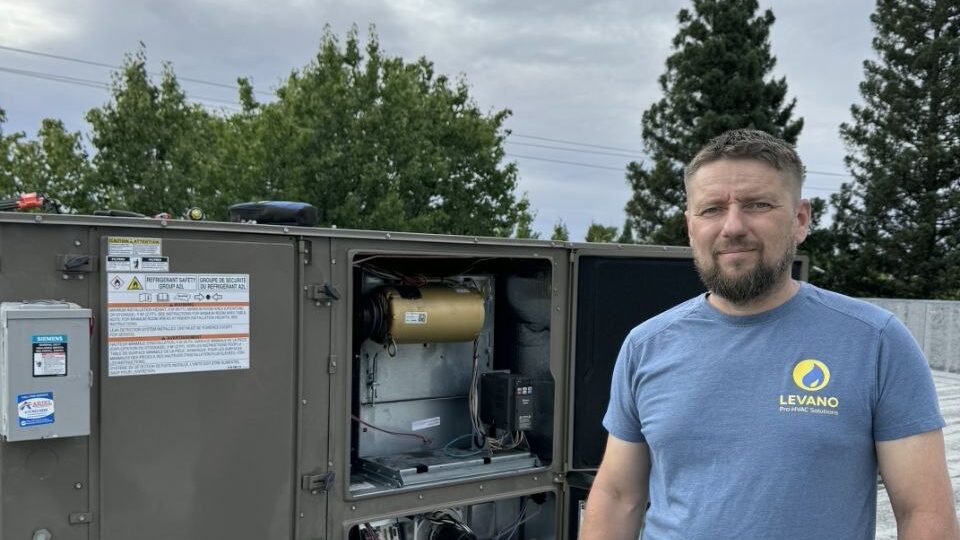
- New equipment uses a different refrigerant. R-454B is classified A2L, which means mildly flammable. That is why you now see a yellow diamond safety label on new outdoor units. It changes how the equipment is built and how it is handled, and it means you cannot simply put the new refrigerant into an old system.
What this means when your AC needs refrigerant
The first thing worth saying plainly: refrigerant is not consumed. A sealed system does not use it up the way an engine uses oil. If your system is low, it is leaking. Anyone who tops you up annually without finding the leak is selling you the same repair every summer.
So when a system is low, there are only three honest options:
- Find and repair the leak, then weigh in a correct charge. This is the right answer when the leak is accessible, such as a fitting, a service valve or a line set connection.
- Add refrigerant as a stopgap and tell you it is a stopgap. Reasonable in the middle of a heat wave when you need the house liveable and the real repair has to wait. Not reasonable as a permanent plan.
- Replace the system. When the leak is in the evaporator or condenser coil on an older unit, the coil repair often costs a large fraction of a replacement, and you are putting it into equipment that is already near the end.
The rising cost of R-410A moves that third option forward for older systems. A large charge on a fourteen year old unit is money spent on equipment you will replace soon anyway.
The one to actually worry about: R-22
If your system was installed before about 2010, it may run on R-22, which stopped being produced or imported in the United States in 2020. Only reclaimed stock remains, and the price reflects that. On an R-22 system with a significant leak, we will usually tell you not to recharge it. The money is better spent on a replacement, and the rebates available on a new heat pump often cover a meaningful part of the difference. Our SMUD rebate guide covers what is available locally.
Does the new refrigerant affect what you should buy?
Not as much as people expect. A few practical points:
- You cannot convert an R-410A system to R-454B. The systems are engineered differently. Anyone offering to do it is not someone you want touching your equipment.
- The A2L label is not a reason to avoid new equipment. Mildly flammable in this classification means it is difficult to ignite and the equipment is built with that in mind. Every manufacturer has moved to it.
- Parts and service for your existing system are not going away. R-410A equipment will be serviceable for years. The cost of the refrigerant itself is what changes.
- If you are replacing anyway, you will get the new refrigerant. That is fine, and it future-proofs the system against the next step down.
How we handle it
Our diagnostic is a flat $69 and it is credited toward the repair. On any low charge call we do a leak search before we quote a charge, because adding refrigerant without finding the leak is selling you a repair that fails. We tell you which refrigerant your system uses, where the leak is, what the repair costs and what it costs to walk away and replace instead.
Related reading: AC repair cost in Sacramento, compressor replacement cost, how long an air conditioner lasts, and the cost calculator for a replacement range. If the system is down right now, see emergency and same-day repair.
Frequently asked questions
Why is refrigerant so expensive now?
R-410A production is being stepped down under the federal AIM Act, which reduces supply and raises the price over time. R-22, used in systems installed before roughly 2010, has not been produced or imported in the United States since 2020, so only reclaimed stock remains and it costs considerably more.
Is R-410A banned? Do I have to replace my AC?
No. R-410A is still available for servicing existing systems and your equipment is not illegal. What changed is that new equipment is built for lower impact refrigerants, and the cost of servicing older systems rises gradually as supply is reduced.
What is R-454B and why does my new unit have a yellow warning label?
R-454B is the refrigerant most manufacturers moved to for new residential equipment. It is classified A2L, meaning mildly flammable, which is why new outdoor units carry a yellow diamond safety label. The equipment is engineered for it and it is the industry standard now.
Can I convert my old system to the new refrigerant?
No. The systems are engineered for different pressures and different oils, and the safety requirements differ. Any contractor offering to convert an R-410A system to R-454B is not someone you should let work on your equipment.
My AC needs refrigerant every summer. Is that normal?
No. A sealed system does not consume refrigerant. If it is low every year, it has a leak. Repeated top-ups without a leak search are a recurring charge for a problem nobody fixed, and the underlying leak keeps getting worse.
Should I recharge my old R-22 system or replace it?
On an R-22 system with a meaningful leak we usually recommend replacement. The refrigerant is expensive, the equipment is at least fifteen years old, and utility rebates on a new heat pump often cover a useful share of the cost.