


A breaker trips because it is doing its job. Something in the circuit drew more current than the breaker is rated for, and it opened before the wiring got hot enough to start a fire. That is the part people forget while they walk back to the panel for the fourth time.
So the rule up front: reset it once. If it trips again, stop. Repeated resetting of a breaker that keeps tripping is how electrical fires start, and every reset also hits the compressor with another hard start.
What is safe for you to check
Two things, and then stop.
- The filter. A badly clogged filter makes the blower and the whole system work harder and run hotter. It is an easy contributor to rule out.
- The outdoor unit. Look for obvious obstruction of the fan, a coil packed solid with cottonwood and grass, or something jammed in the fan blade. Do not put your hands in it, and do not remove the electrical panel.
Everything past that involves a capacitor that can hold a lethal charge after the power is off, and line voltage wiring. That is genuinely not a homeowner job.
The usual causes, in the order we find them
- A failing run capacitor. The most common one. A weak capacitor makes the compressor draw very high current trying to start, which trips the breaker. It is an inexpensive part and a short visit, and it is why we check it first.
- A dirty condenser coil. The unit cannot reject heat, head pressure climbs, current climbs with it, and the breaker opens. Frequently the fix is a cleaning rather than a part. This peaks in Sacramento in July and August for obvious reasons.
- A failing condenser fan motor. A motor with worn bearings draws more current as it struggles, and when it stops turning the unit overheats within minutes.
- A compressor that is failing or seizing. A compressor drawing locked rotor amps trips a breaker almost immediately. This is the expensive answer, and it is why the diagnosis matters before anyone quotes.
- A shorted or damaged wire. Rodent damage is common in Sacramento crawlspaces and attics. Insulation rubbed through at a sharp edge is common in older installations.
- A weak or undersized breaker. Breakers wear out. One that has tripped hundreds of times over fifteen years can start tripping at loads it used to handle. It can also be the wrong size for the unit, which happens after an equipment change where nobody checked the nameplate.
Which breaker is tripping tells you something
If the outdoor disconnect or the condenser breaker trips, the fault is almost certainly in the outdoor unit: capacitor, fan motor, compressor or the wiring to it.
If the air handler or furnace breaker trips, look at the blower motor, the control board or the wiring inside. If your system is a heat pump and it trips in heating, the electric backup heat strips are a strong candidate, because they draw far more current than anything else in the system.
If the breaker trips the moment the compressor tries to start, that points at the capacitor or the compressor. If it trips after twenty minutes of running, that points at heat: a dirty coil, a struggling fan motor, or a system running at high head pressure.
The thing that makes this urgent
Every trip and reset cycle is a hard start on the compressor. Compressors are rated in starts, not hours, and a locked rotor start is the hardest thing that happens to one. A capacitor that could have been replaced cheaply on Monday can become a compressor replacement by Thursday if the system keeps getting reset through a heat wave.
There is also the electrical side. A breaker tripping repeatedly means something is drawing current it should not. Treating that as an inconvenience rather than a warning is how a bad connection becomes a burned panel.
What we do
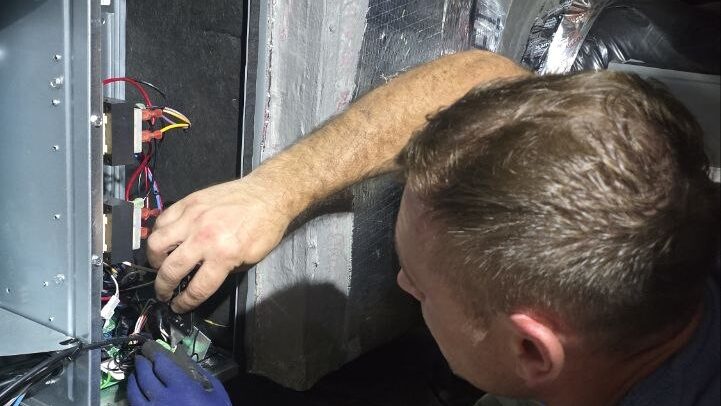
We measure the actual current draw on the compressor and the fan motor, test the capacitor under load, check the coil condition and inspect the wiring and the breaker itself. Those measurements separate a twenty dollar part from a failing compressor, and both present identically at the panel. Our diagnostic is a flat $69 and it is credited toward the repair.
If the house is without cooling in serious heat, emergency and same-day repair covers how quickly we can get there. Related: AC not turning on and AC repair cost in Sacramento.
Frequently asked questions
How many times can I reset the breaker?
Once. If it trips a second time, leave it off and call. Repeated resets are an electrical fire risk and each one puts a hard start on the compressor, which can turn a cheap repair into an expensive one.
Why does my AC trip the breaker only on hot days?
Because heat raises the load. A dirty condenser coil or a struggling fan motor pushes head pressure and current up as the outdoor temperature climbs, so the system crosses the breaker’s threshold on a 105 degree afternoon and not on an 85 degree one.
Could it just be a bad breaker?
Sometimes, and it is worth checking. Breakers weaken with age and repeated tripping, and occasionally the wrong size was installed after an equipment change. That said, it is the least common cause and it should be confirmed by measuring the actual current draw, not assumed.
Is a tripping breaker dangerous?
The breaker itself is the safety device working correctly. The danger is in defeating it by resetting repeatedly, or in the underlying fault, which can be damaged wiring. Treat repeated tripping as a warning rather than a nuisance.
Can I replace the capacitor myself?
We would not recommend it. A run capacitor stores a charge that can injure or kill even after the power is disconnected, and it has to be discharged properly first. It is an inexpensive part and a short visit for someone who does it daily.
My heat pump trips the breaker in winter. Is that different?
Usually yes. In heating mode, electric backup heat strips draw far more current than anything else in the system, so they are the first suspect along with their sequencer or contactor. It points to a different part of the system than a summer trip does.