


Nothing. You push the setpoint down, and the house stays exactly as quiet as it was.
An air conditioner that will not start is a different problem from one that runs but blows warm air, and it is usually cheaper to fix. Most of the time something cut the power on purpose, because a safety device did its job. Here is how to find out which one.
First, work out what exactly is not happening
Three very different faults get described as “the AC won’t turn on.” Sort yours before you go any further.
- The thermostat screen is blank. No power to the thermostat itself. Start with batteries and the low-voltage supply.
- Thermostat works, nothing else does. No blower indoors, no fan outdoors. Usually a tripped safety or a lost low-voltage circuit.
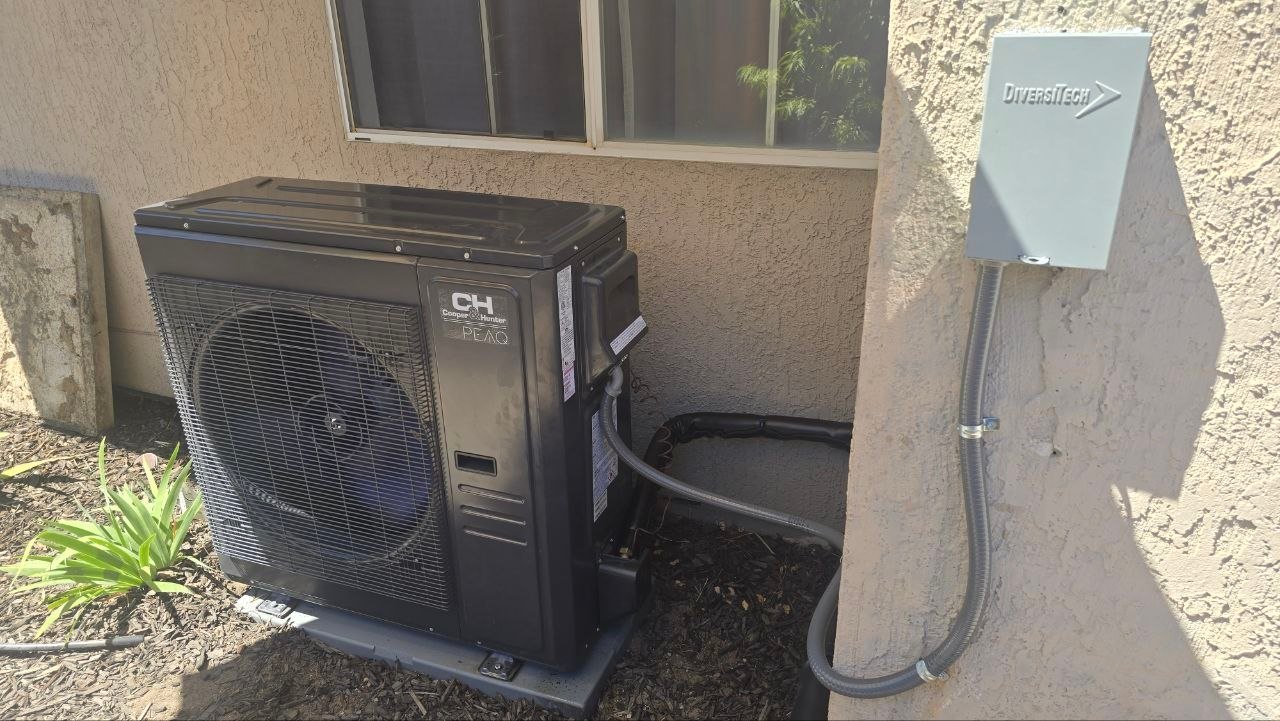
- Indoor blower runs, outdoor unit is dead silent. The indoor half has power and the outdoor half does not. That points at the outdoor breaker, the disconnect, or the contactor.
That last one is the most common version we get called for, and it is also the one with the cheapest happy ending.
Five things to check before you call
- Thermostat batteries and mode. A blank screen on a battery-powered thermostat is often just batteries. And check the mode actually says COOL, not OFF or HEAT, because a thermostat that lost power sometimes comes back on defaults.
- Both breakers. Your system has two: one for the indoor air handler or furnace, one for the outdoor condenser. Look for a breaker sitting slightly off-centre rather than fully flipped, which is what a tripped one usually looks like. Reset it once, all the way off then on. If it trips again, stop. That is a short, and repeatedly resetting it is how a small repair becomes a big one.
- The outdoor disconnect. There is a small grey box on the wall beside the condenser. Inside is a pull-out handle. It gets pulled during service or yard work and occasionally does not get pushed back. Open it and look. If the handle is out or upside down, that is your afternoon solved.
- The float switch. If your air handler is in the attic, it sits in a drain pan with a safety switch. When the condensate drain clogs and the pan fills, that switch cuts the system deliberately so you do not get a ceiling stain instead. A system that shut itself off in the middle of a hot week, with no other symptom, is very often this. Look for standing water in the pan, and see our guide to an AC leaking water for what causes it.
- The blower door. The access panel on the furnace or air handler has a plunger switch behind it that kills power when the panel is off. If anyone has been in there recently, including for a filter change, make sure the panel is seated properly and latched.
Those five account for a large share of the calls where we arrive and there is nothing actually broken.
What it is when it is a real fault
The contactor
The contactor is the relay in the outdoor unit that closes and lets the compressor run. The contacts pit and corrode over years of switching under load, and eventually they stop making a connection. Classic symptom: thermostat calls for cooling, indoor blower runs, outdoor unit does absolutely nothing. It is an inexpensive part.
Ants, oddly, are a real cause of this in our area. They get into the contactor housing and short it out. We see it every summer.
The capacitor
If the outdoor unit hums but nothing spins, that is a capacitor, not a contactor. The power is arriving, but the motor has no starting torque. Also cheap, also a short visit. We go into it in more detail in the guide to an AC blowing warm air, because a weak capacitor shows up in both symptoms.
A blown low-voltage fuse or failed transformer
Your thermostat runs on 24 volts from a transformer, protected by a small fuse on the control board. A pinched or shorted thermostat wire blows that fuse, and everything goes dead at once, thermostat included. Replacing the fuse without finding the short just blows another one.
In this area the short is often rodent damage. Wiring in attics and crawlspaces gets chewed, and the failure shows up months later.
The control board
Boards fail, particularly ones that have spent ten summers in a 130-degree attic. This is the most expensive of the common causes and worth a second opinion if the system is otherwise healthy.
A seized compressor
The unhappy answer. If the compressor is locked, you get a loud hum and a breaker trip within seconds. On a system out of warranty this is usually a replacement conversation rather than a repair, for the reasons set out in our new HVAC system cost guide.
The local pattern
Two things drive most of the no-start calls we take between May and September here.
The first is heat. Contactors and capacitors are the parts that fail from switching under load in high ambient temperatures, and a condenser on a west wall in a Sacramento afternoon is doing exactly that. Equipment is rated at 95 degrees. We routinely run well above it.
The second is condensate. Attic air handlers are standard in Natomas, Pocket and most of the newer tracts, and the drain lines clog with algae over a season. The float switch then shuts the system down on the hottest week of the year, which feels like a catastrophic failure and is actually a drain line and twenty minutes.
Both are things a spring tune-up catches. That is not a sales line, it is why the tune-up exists.
When to stop and call
Call today if:
- the breaker trips again after one reset
- you hear a loud hum followed by a trip
- you smell anything burnt
- you find water in the drain pan
Waiting on any of those costs more, not less.
It can wait if the system simply will not start and there is no noise, no smell and no water. That is usually a contactor or a fuse, and it is not getting worse overnight.
Do not call if the disconnect handle was pulled out or the blower door was loose. Push it back, latch it, and keep your money.
What we actually do
Diagnostic is a flat $69 and it goes toward the repair if you have us do the work. No separate trip fee stacked on top.
We start at the thermostat and work outward with a meter rather than guessing: confirm 24 volts is present, check the fuse and transformer, test the contactor and capacitor against spec, verify the float switch and door switch are closed, and check amp draw on the compressor before we say anything about it. Then you get told which of the causes above it is, and what each option costs.
We cover Sacramento, Roseville and the towns around them. For Roseville, see our AC repair page; for the city, AC repair in Sacramento; for Rocklin, see the dedicated page, and the same for Folsom, Citrus Heights and Elk Grove. More on our AC repair page, or call (916) 299-0955.
Wondering about the bill before you call? Our guide to what AC repairs cost in Sacramento lists the common repairs with real ranges and how to read an estimate.
If the system tries to start and the breaker goes with it, do not keep resetting it. Read why your AC keeps tripping the breaker first, because each reset is a hard start on the compressor.
Frequently asked questions
Why is my AC not turning on?
Most often something cut the power deliberately: a tripped breaker, a pulled outdoor disconnect, a condensate float switch that shut the system down because the drain pan filled, or a blower access panel that is not latched. If those are fine, the usual faults are a worn contactor, a failed capacitor, a blown low-voltage fuse or a failed control board.
The indoor fan runs but the outdoor unit does nothing. Why?
The indoor and outdoor halves are on separate circuits. If the blower runs and the condenser is silent, look at the outdoor breaker, the disconnect box on the wall beside the unit, and then the contactor inside it. A worn contactor is the most common cause of that exact pattern.
Why did my AC shut itself off and not come back on?
On an attic system this is very often the condensate float switch. The drain line clogs, the pan fills, and the safety switch cuts the system on purpose to prevent water damage. Check the pan for standing water.
Should I keep resetting the breaker?
Reset it once. If it trips again, stop and call. A breaker that trips repeatedly is protecting you from a short or a seized compressor, and forcing it back on can turn an inexpensive repair into an expensive one.
How much does it cost to diagnose an AC that will not start?
Our diagnostic is a flat $69 across Sacramento and Roseville, and it goes toward the repair if we do the work.
If it is the furnace rather than the air conditioner, and it runs but the air is cold, that is a different list: see why a furnace blows cold air.