


HVAC quotes and repair notes throw these names around as if everyone knows them. Most people do not, and it matters, because the difference decides what is being replaced and what it costs. Here is what each part is and where it lives.
The two halves of a split system
Most Sacramento homes have a split system: one unit outside and one inside, connected by a pair of copper refrigerant lines and a control wire.
- Outside: the condenser, if you have an air conditioner, or the heat pump outdoor unit, if you have a heat pump.
- Inside: a furnace or an air handler, with an evaporator coil attached.
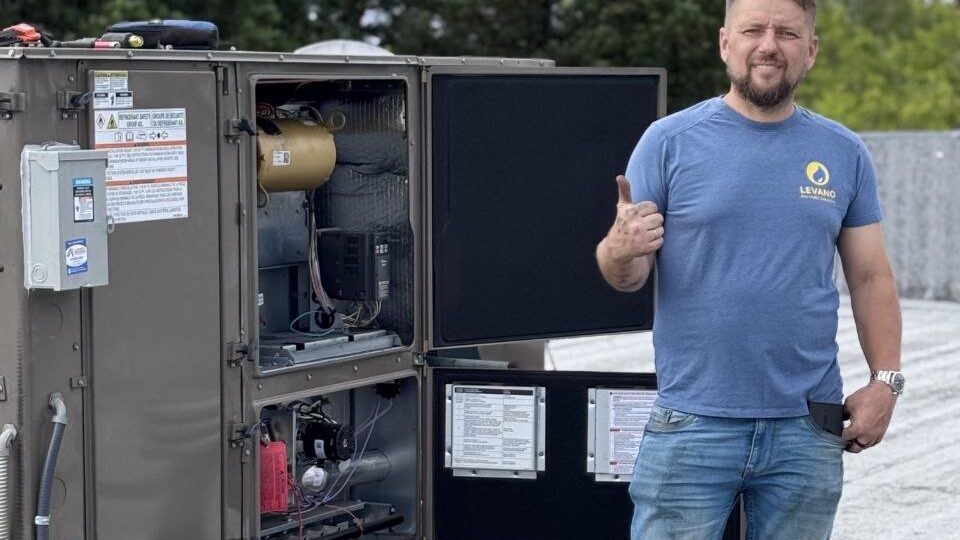
Some homes, especially with flat roofs, have a package unit instead, where everything sits in one cabinet on the roof or beside the house, like the unit in the photo above.
Condenser
The outdoor unit of an air conditioner. It contains the compressor, the condenser coil and a fan. Its job is to dump the heat that was removed from your house into the outdoor air. That is why the air blowing out of it in summer is hot. The compressor inside it is the most expensive single part in the system. See compressor replacement cost.
Heat pump outdoor unit
Looks almost identical to a condenser, but it can run in reverse. In summer it dumps heat outside. In winter it pulls heat from the outdoor air and brings it in. The extra parts are a reversing valve and defrost controls. See heat pump defrost explained.
Evaporator coil
The indoor coil, usually in a box on top of the furnace or inside the air handler. Cold refrigerant runs through it, the blower pushes house air across it, and the air comes out cool and drier. The water it pulls from the air drips into a drain pan and leaves through the condensate line. When that line clogs, you get water leaks. See furnace leaking water.
Furnace
The indoor unit that creates heat by burning natural gas or, less often, propane. It also contains the blower that moves air through the whole house, for heating and for cooling. In most Sacramento homes with gas, the furnace does double duty as the air mover for the air conditioner.
Air handler
The indoor unit in homes without a gas furnace. It holds the blower, the evaporator coil and controls, but it does not burn fuel. It is paired with a heat pump, and often has electric heat strips inside for backup heat. See air handler not turning on and air handler replacement cost.
Why the names matter on a quote
- “Replace the condenser” means the outdoor unit only. It must still match the indoor coil.
- “Replace the coil” means the indoor evaporator coil, which requires refrigerant work.
- “Replace the furnace” means the indoor heating unit, and often the coil if it is attached and old.
- “Full system” means outdoor unit, indoor unit and coil together.
Mismatched components can lose efficiency and warranty coverage. See how to compare HVAC quotes.
Where the thermostat, ducts and filter fit
- Thermostat: tells the system when to run. See thermostat problems.
- Ducts: carry air between the indoor unit and the rooms. See what size ductwork you need.
- Filter: protects the blower and coil. See air filter sizes and MERV.
What we do
When we quote a repair or replacement, we name every component and model so you know exactly which part is changing. Our diagnostic is a flat $69 and it is credited toward the repair, and replacement estimates are free.
Frequently asked questions
What is the difference between an air handler and a furnace?
A furnace burns gas to create heat and also moves air. An air handler moves air and holds the coil but does not burn fuel. It is usually paired with a heat pump and may have electric heat strips.
What is the difference between a condenser and an evaporator?
The condenser is the outdoor unit that releases heat outside. The evaporator is the indoor coil that absorbs heat from your home’s air.
Is the condenser the same as the AC unit?
In everyday use, the outdoor AC unit is called the condenser. It contains the compressor, the condenser coil and a fan.
Does a heat pump have a furnace?
Usually no. A heat pump is paired with an air handler that often includes electric backup heat. Some homes have a dual fuel setup with a heat pump and a gas furnace.
What is a package unit?
A system with all components in one cabinet, usually on a roof or beside the house, instead of split between inside and outside.
Do I have to replace the indoor and outdoor units together?
Not always, but they must be a matched combination. On older systems, and with the refrigerant change, replacing both is often better value.