


The thermostat is the cheapest control you have over your energy bill. Sacramento has hot summers and mild winters, so the right setting changes through the year. Here is what the U.S. Department of Energy suggests, and how to adjust it for a heat pump.
Winter settings
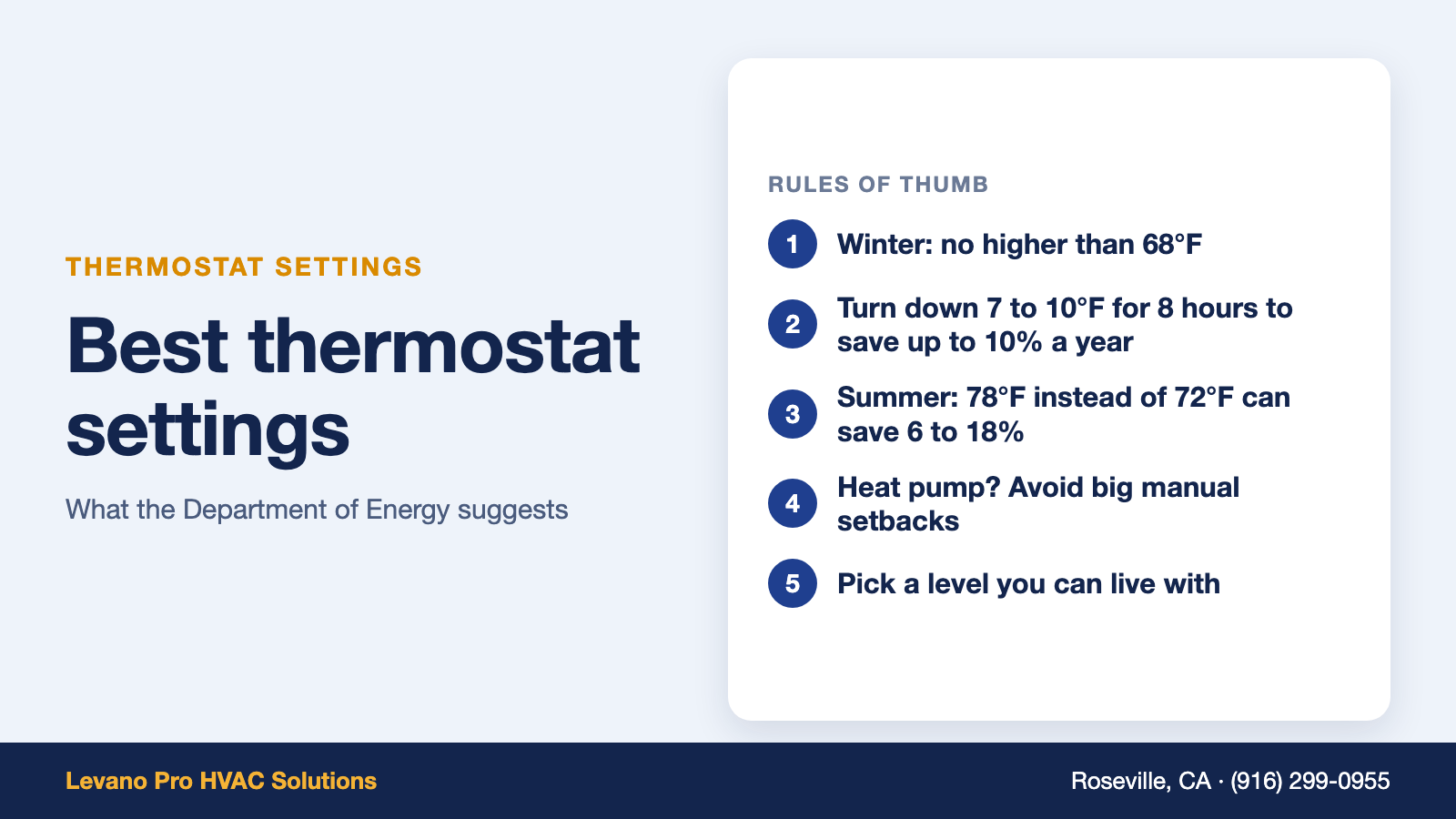
The Department of Energy’s long-standing guidance is to set the thermostat no higher than 68°F when you are home and awake, and lower while you sleep or are away. Its newer statements stress that people should choose a temperature they find comfortable. A practical approach:
- 68°F while you are awake at home
- Lower while you sleep, as far as is comfortable under blankets
- A noticeable setback while the house is empty
Summer settings
The Department of Energy says that setting the thermostat to 78°F instead of 72°F can save 6 to 18 percent on cooling. In Sacramento, where the AC runs from May into October, that adds up. If 78°F feels too warm, try 77°F and use ceiling fans. Fans cool people, not rooms, so turn them off when you leave.
How much a setback saves
The Department of Energy says you can save as much as 10 percent a year on heating and cooling by turning the thermostat back 7 to 10 degrees for 8 hours a day. Its Energy Saver materials give a rule of thumb of about 1 percent for each degree and each 8 hour setback. A programmable or smart thermostat can do this automatically. We have not compared specific models here, because the savings depend on how the thermostat is set up and used.
The heat pump exception
If you have a heat pump, the best setting is usually steadier. The Department of Energy warns that manually turning a heat pump thermostat back and then up again can trigger the electric resistance backup heat when the system tries to recover quickly. That backup heat costs much more to run than the heat pump itself. The department recommends using a programmable or smart thermostat designed for heat pumps, which raises the temperature gradually. A Building America field study found that recovery from setback lowers a heat pump’s efficiency but still expects net savings. If your bill is higher than expected, see heat pump high electric bill.
Where to put the thermostat
A thermostat reads the temperature where it hangs. Mounted in direct sun, over a vent or on an exterior wall, it will read wrong and run the system too much. Keep it on an interior wall away from windows, lamps and supply vents. If your thermostat seems to change settings by itself, see thermostat changing temperature by itself.
When the thermostat is the problem
- Blank screen or no response: replace the batteries, then see thermostat not working.
- Flashing Cool On: see thermostat cool on blinking.
- Replacing an old thermostat: see thermostat wiring colors and thermostat replacement cost.
A simple year-round plan
- Set winter to 68°F while home and a few degrees lower overnight.
- Set summer to 78°F while home and higher while away.
- Use a setback of 7 to 10 degrees if you are gone for a workday and have a furnace or AC.
- If you have a heat pump, use a thermostat built for it and avoid big manual changes.
- Check the thermostat location and replace batteries at least once a year.
If your home never reaches the setting, or your bills stay high, the cause may be the equipment, not the thermostat. See why is my heating bill so high, or contact us for a diagnostic. We serve Roseville, Rocklin, Folsom and Elk Grove.
Frequently asked questions
What temperature should I set my thermostat in winter?
The Department of Energy has long advised setting it no higher than 68°F when you are home, and lower when you are asleep or away. Comfort matters too, so pick the lowest setting you are happy with and use a sweater before you raise it.
What temperature should I set my AC in summer?
The Department of Energy says that setting the thermostat to 78°F instead of 72°F can save 6 to 18 percent on cooling costs. Sacramento summers are hot, so many homeowners settle on 78°F while home and a higher setting while away.
How much can a thermostat setback save?
The Department of Energy says you can save as much as 10 percent a year by turning the thermostat back 7 to 10 degrees for 8 hours a day, such as while you sleep or while you are at work. A common rule of thumb is about 1 percent per degree for each 8 hour setback.
Should I set back a heat pump thermostat?
Be careful. Large manual setbacks on a heat pump can trigger the electric resistance backup heat when the system tries to recover, which costs more to run. The Department of Energy advises using a thermostat designed for heat pumps and avoiding big manual changes.
Does leaving the AC or heat on all day use less energy?
Not usually. The savings come from letting the house drift closer to the outdoor temperature while no one is home. A smaller setback of a few degrees is a practical compromise if you want a comfortable return.