


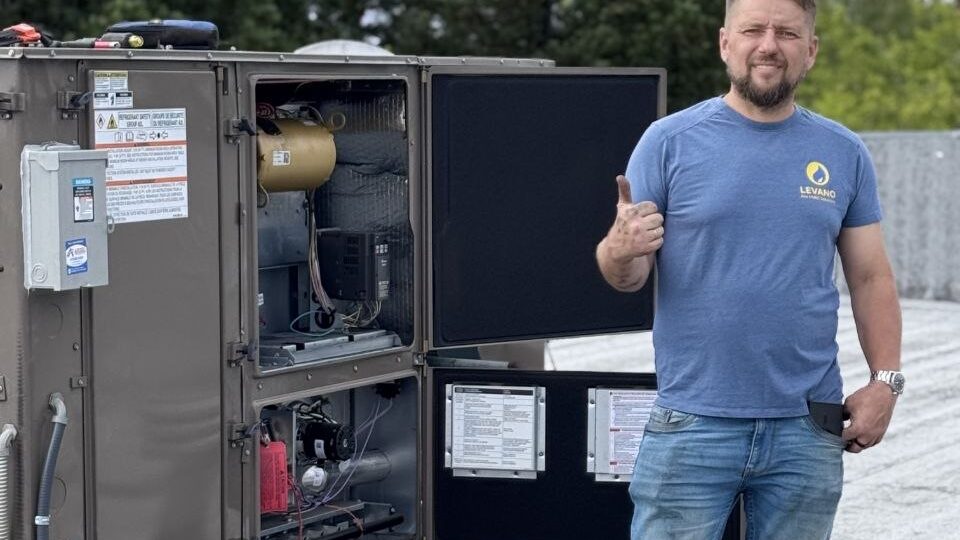
Almost every no-cooling call we take in July was preventable in April. Not because the equipment was doomed, but because a filter, a coil or a drain line was quietly strangling a system that then met its first 105 degree afternoon and gave up. This is the list we would run on our own house, in the order that matters.
Do this yourself, in about an hour
- Change the filter and write the date on it. Not the date you should change it next, the date you put it in. Guessing is how filters end up a year old. In most Sacramento homes a one inch filter needs replacing every 60 to 90 days, and less if you have pets or live near open fields in Elk Grove, Natomas or west Roseville.
- Clear three feet around the outdoor unit. Oleander, jasmine, a fence panel someone leaned there in winter, the recycling bin. The condenser rejects heat into the air around it. If that air cannot move, the system runs hotter and works harder for the same cooling.
- Rinse the condenser coil. Shut the power off at the disconnect box next to the unit, then rinse the fins gently with a garden hose, top to bottom. No pressure washer. Cottonwood and grass clippings pack those fins solid by June.
- Open every supply register and check the returns. People close vents in winter and forget. A closed register does not save money on a central system, it raises static pressure and makes the blower work harder. Move furniture off the return grille while you are at it.
- Pour a cup of distilled vinegar down the condensate drain. Find the PVC line near the indoor unit, locate the access cap, and pour it in. Algae in that line is the single most common reason a system shuts itself off in August, and it is a five minute job in spring.
- Run the system in cooling for fifteen minutes and listen. Do this on a mild day, not the first hot one. You want to find the problem while you still have options. Note anything new: a rattle, a screech, a click that repeats, a smell.
- Check the thermostat batteries and the schedule. Batteries die at the worst time. Schedules that someone set two summers ago are usually wrong for how the house is used now.
What needs a technician
Three things on the list cannot be done from the patio, and they are the ones that actually prevent failures.
- Refrigerant charge verified, not topped off. A system low on charge cools poorly, ices up, and eventually kills the compressor. Charge is verified by measuring superheat and subcooling, not by looking at a gauge. And a system that is low is leaking, because refrigerant is not consumed.
- Electrical components tested under load. Run capacitors are the number one summer failure in this valley. A capacitor can look fine and still test weak on a meter. Replacing a marginal one in April costs a fraction of an emergency call in July.
- The evaporator coil and drain pan inspected. The indoor coil collects dust that the filter missed. A dirty coil cuts capacity and freezes up on the hottest days, which is exactly when you notice.
What a proper visit includes, and what a sales visit dressed up as one looks like, is in what an HVAC tune-up costs and includes.
The Sacramento specifics
Three things about this valley change the standard advice.
Our design temperature is brutal and our nights are not. Sacramento regularly runs 100 to 108 in July and August, but drops into the 60s overnight. That means a marginal system will still seem fine in May and June and then fail in the first sustained heat event. Test in spring under load, not in the mild weather when everything passes.
Attic duct work is the hidden problem. In Natomas, Elk Grove and the newer parts of Roseville and Rocklin, the duct work runs through an attic that reaches 130 degrees. Leaky ducts there are not a small efficiency loss, they are a system that cannot reach setpoint on the worst day. If your house has never kept up in a heat wave, the answer is often the ducts rather than the equipment. Our article on duct sealing versus replacement covers the fix.
Wildfire smoke season overlaps cooling season. When the air is bad you will run the system with the house closed up for days. A filter that was adequate in June will be loaded by September. Our guide to filters and wildfire smoke explains which rating actually helps without choking the airflow.
What to do if something on the list looks wrong
If the coil is filthy, if the unit is loud in a new way, or if the house never quite reached setpoint last September, deal with it now rather than in the queue behind everyone else in a heat wave. Our diagnostic is a flat $69 and it is credited toward the repair. A seasonal tune-up covers the technician side of this list.
If the system is already fifteen years old and you are weighing another season against a replacement, the cost calculator gives a range in about a minute, and SMUD heat pump rebates may cover a meaningful part of it.
Frequently asked questions
When should I get my AC serviced in Sacramento?
March through May, before the first sustained heat. A marginal system passes every test in mild weather and fails on the first 105 degree afternoon, when every company in the valley is booked. Spring is also when you can still get an appointment quickly.
How often should I change my air filter here?
Every 60 to 90 days for a standard one inch filter, and more often with pets, during wildfire smoke season, or if you live near open fields. Write the install date on the edge of the filter so you are not guessing.
Can I wash the outdoor unit myself?
Yes, carefully. Turn the power off at the disconnect box beside the unit, then rinse the fins gently with a garden hose. Never use a pressure washer, because the fins bend easily and bent fins permanently reduce the unit’s ability to shed heat.
Is a tune-up actually worth paying for?
It is when it includes measuring the refrigerant charge properly, testing the electrical components under load and inspecting the indoor coil. It is not when it is a filter change and a sales pitch. Ask what gets measured before you book.
My house never gets cool on the hottest days. Is the AC too small?
Sometimes, but leaking attic duct work is the more common cause in Sacramento tract housing. Ducts running through a 130 degree attic lose both airflow and cooling capacity. Static pressure and duct leakage should be measured before anyone sells you a bigger system.
What is the one thing most people skip?
The condensate drain. Algae grows in that line all summer, the float switch trips, and the system shuts off on the hottest day of the year. A cup of distilled vinegar down the line in spring prevents most of those calls.