


When wildfire smoke arrives, people look for a fast fix. The options range from a better filter to a whole-house air purifier that costs thousands. The federal guidance is clearer than most sales pitches, and it starts with the cheapest option.
What EPA and AirNow recommend first
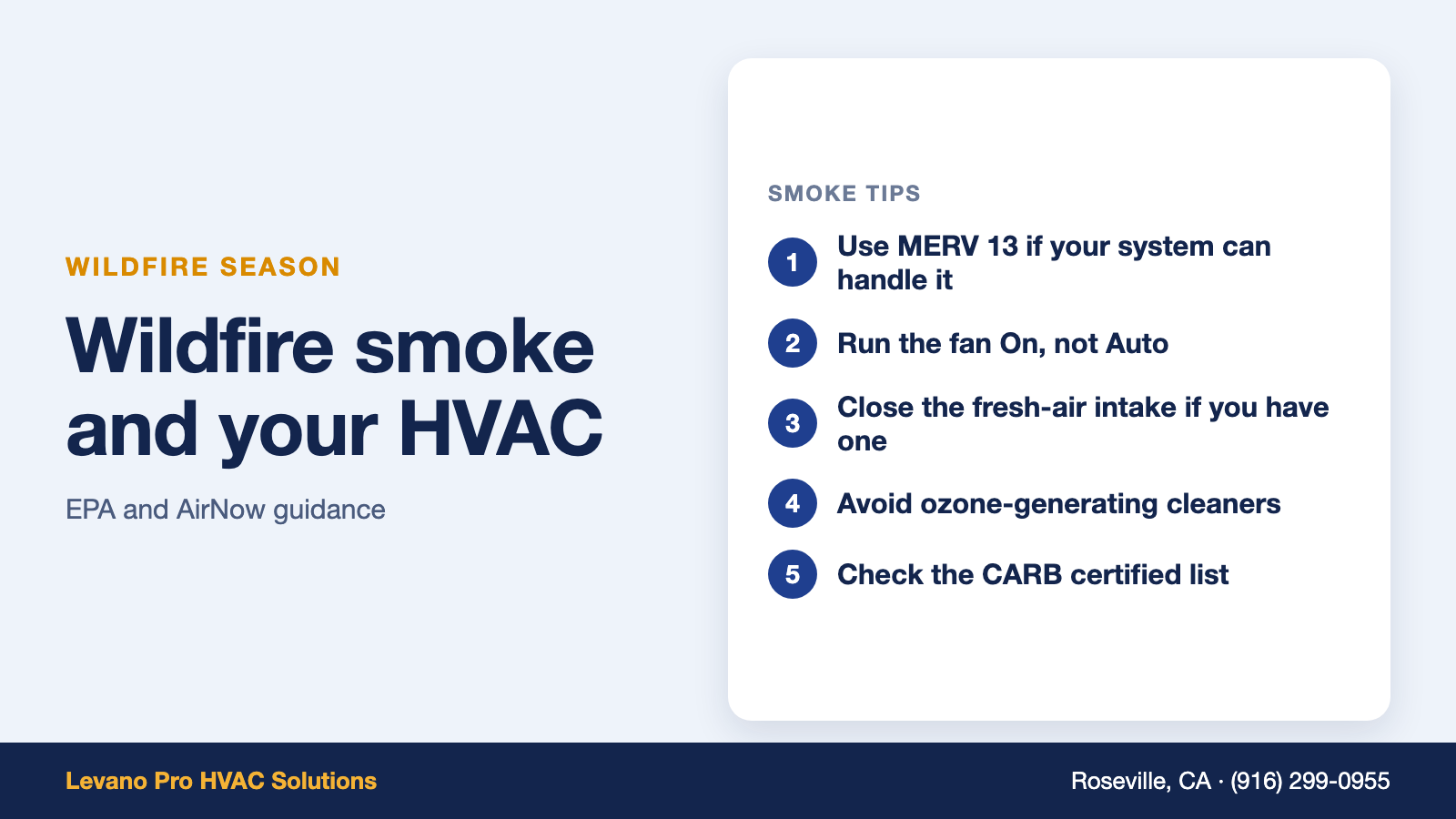
- Use a MERV 13 filter, or the highest rating your system and filter slot can accommodate. It should fit snugly. A technician may need to confirm compatibility.
- Run the fan on instead of auto, so air is filtered continuously.
- Close the fresh-air intake or set it to recirculate, if your system has one.
- Use a portable air cleaner sized for the room, with no ozone, and run it on high.
- Replace filters more often than the manufacturer recommends during smoke, and keep spares on hand.
AirNow adds to stock filters before smoke arrives and to choose one clean-air room.
Check what your system can handle
A thicker or higher-MERV filter can restrict airflow. AirNow says to use MERV 13 or higher only if your HVAC system can safely handle it, and EPA’s own advice is as high a rating as your fan and filter slot can accommodate. Our guide on wildfire smoke and your HVAC filter goes deeper, and air filter sizes and MERV ratings covers the sizes.
Whole-house purifier options
- Media filter cabinets that hold a thick, high-efficiency filter.
- Electronic air cleaners that charge and collect particles.
- UV or hybrid units that combine filtration with UV. EPA says UV does not capture particles. See UV lights in HVAC.
Watch for ozone
EPA says to avoid air cleaners that intentionally produce ozone, and some UV and electronic devices can make it. In California, portable air cleaners must be CARB certified for ozone and electrical safety, and electronic in-duct air cleaners have been covered since October 2020. CARB certification does not measure how well a device cleans, so also check the clean air delivery rate against your room size. Check the CARB list of certified devices.
What it costs
Angi’s cost guide lists whole-house air purifiers averaging about $2,600 across types, with UV models at roughly $750 to $3,500 and hybrid units at roughly $900 to $3,500. We could not confirm the update date of those figures, so treat them as a rough range. A better filter and a portable cleaner cost much less.
What to buy first
- A good MERV 13 filter, if your system can handle it, and spares.
- A portable cleaner for the bedroom or main room, from the CARB list.
- Sealing leaks around doors and windows.
- Only then, consider a whole-house system, with advice from a technician.
If you already have a system
Have it checked before smoke season. A technician can confirm which filter your system can handle, check the filter slot for gaps, and check airflow. See what a tune-up includes and our indoor air quality services.
We serve Roseville, Rocklin, Folsom and Elk Grove. Contact us to talk through your options.
Frequently asked questions
Do I need a whole-house air purifier for wildfire smoke?
Not necessarily. EPA advises using a MERV 13 filter, or the highest rating your system and filter slot can handle, and running the fan on. A portable air cleaner in the room you use most is another option. A whole-house purifier is an upgrade, not a first step.
Can my HVAC system handle a MERV 13 filter?
Not always. AirNow says to use MERV 13 or higher if your HVAC system can safely handle it, and to ask a professional. EPA says to use as high a rating as your system fan and filter slot can accommodate. A thicker filter can restrict airflow in some systems.
Should I run the fan on or auto during smoke?
EPA says to run the fan on instead of auto during smoke so air is filtered continuously. If your system has a fresh-air intake, close it or set it to recirculate.
Are ozone generators a good air cleaner?
No. AirNow says not to use an ozone-generating air cleaner, and EPA advises avoiding devices that intentionally produce ozone. In California, portable air cleaners must be CARB certified, and CARB keeps a list of certified devices.
How much does a whole-house air purifier cost?
Angi’s cost guide lists whole-house air purifiers averaging about $2,600 across types, with UV models at roughly $750 to $3,500 and hybrid units at roughly $900 to $3,500. Prices vary widely, and the guide’s update date was not confirmed.