


“Central air conditioner” covers a specific thing: a ducted split system, condenser outside, coil and air handler or furnace inside. That’s what’s on the side of most houses around Roseville, Rocklin and Sacramento, and it’s a different buying decision than a mini-split or a window unit. So this is a ranking of the best central air conditioner brands for a valley that hits 105 and stays there.
One thing before the list. A SEER2 number belongs to a matched system, not to a condenser. The same outdoor unit paired with a different coil rates differently, and the fancy number on the brochure assumes the pairing the manufacturer tested. If a quote promises you 26 SEER2 without naming the coil, that number is decoration.
The short version
- Most efficient: Lennox. The SL25KCV sits at the top of the residential charts at up to 26.0 SEER2 on a proper match. Read the parts caveat below before you fall in love.
- Best all-around: Carrier. The Infinity 21 runs up to 21 SEER2, with a deep dealer network and, when registered, a choice of 10 years on parts or 5 years parts plus 3 years labor.
- Best warranty and toughness: Trane. The Premier 20 TruComfort tops out at 23.6 SEER2, second only to Lennox, and 12-year compressor coverage when you register is the strongest standard warranty among the majors, which we unpack in our Trane air conditioner review.
- Best value: Goodman and Amana. Its current R-32 lineup runs from the California minimum up to 19.0 SEER2 with the variable-speed GXV9S. Not exotic, but cheap to buy, cheap to fix, and backed by Daikin engineering. We go deeper on that value tier in our Goodman air conditioner review.
Lennox: the efficiency king with an asterisk
If you want the highest number available in 2026, it’s Lennox. The SL25KCV is the most efficient residential AC you can buy today, which we cover in our Lennox air conditioner review, and in a climate where the compressor runs from May through September, efficiency is real money, not a spec-sheet brag.
The asterisk: Lennox distributes repair parts through its dealer network rather than selling them directly. If the company you call in year six isn’t an authorized Lennox dealer, a part that would be same-day for another brand can become a special order. We wrote about that pattern in more detail in our guide to air conditioner brands to avoid. It doesn’t make the equipment bad. It means you should know who services Lennox locally before you buy one, not after.
Carrier: the safe pick
Carrier is what we’d call the low-regret choice. We cover the tiers and the Bryant money-saver in our Carrier air conditioner review. The Infinity 21 gets you up to 21 SEER2 with variable-speed operation that actually helps in a house that bakes unevenly. When you register, you choose 10 years on parts or 5 years parts plus 3 years of labor, which is unusual since most brands leave labor entirely to you.
The dealer network is the quiet advantage. Parts are easy to get, plenty of techs know the platform, and you’re not hunting for the one shop in town that will touch it.
Trane: built for exactly this climate
Trane’s whole personality is durability over headline efficiency. The Premier 20 stops at 23.6 SEER2 while Lennox is out at 26.0, and Trane seems fine with that. What you get instead is 12-year compressor coverage when the unit is registered, the best standard warranty in the group.
For a Central Valley house, that trade is defensible. A system that runs hard for five months a year is a durability problem before it’s an efficiency problem.
Goodman and Amana: the value tier that stopped being a joke
Goodman used to be the punchline. Now it’s owned by Daikin, its R-32 lineup reaches a respectable 19.0 SEER2 with the GXV9S, and the parts are inexpensive and stocked everywhere. That last part matters more than people realize: when a board fails in August, “we can have it tomorrow” beats a premium badge.
It’s not a premium system and we won’t pretend otherwise. Entry-level equipment can lose a coil or a board earlier than a top-tier unit. But if you’re staying in the house five to eight years, or you’re outfitting a rental, this is a rational choice rather than a compromise.
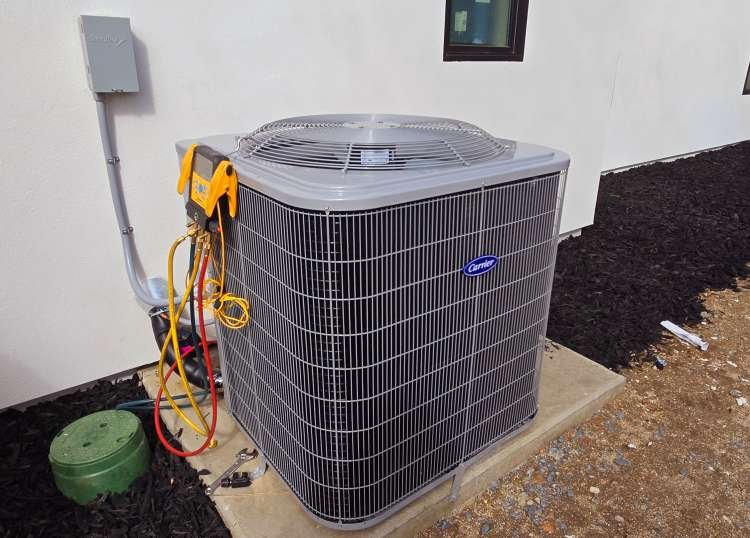
What a central AC actually costs
Real numbers, since everyone dances around this. Most central air conditioner systems run about $5,000 to $12,000 installed. The average homeowner replacing a standard system on existing ductwork pays somewhere around $6,500. The spread comes from tonnage, efficiency tier, and whether your ducts and electrical need work.
If you’re only pricing the condenser, the tiers look roughly like this: under $3,000 is budget, $3,000 to $6,000 is mid-range, $6,000 to $10,000 is premium, and above $10,000 you’re in top-tier variable-speed territory. But nobody buys a condenser alone, which is why condenser-only pricing is how you get surprised at the end.
Our installation and replacement quotes break out what’s driving the number, so you can see where the money goes instead of getting one figure and a shrug.
Does maximum efficiency pay off here?
Sometimes. Sacramento summers are long, so a high-SEER2 system has more hours to earn back its premium than the same unit would in a mild coastal town. That math is real.
But it flips if you’re moving in six years, or if your ductwork leaks a third of the air into the attic. A 26 SEER2 condenser feeding leaky ducts is an expensive way to cool your crawlspace. We’d rather size the system properly and seal the ducts than sell you a bigger number.
How we’d choose, honestly
Pick in this order: who services it locally, does the installer do a real load calculation, what does the warranty cover and when must you register it, and only then the SEER2 number. That order is unglamorous and it’s how you avoid the calls we get in year four.
For the full brand roundup beyond central systems, including mini-splits and heat pumps, see our complete guide to the best air conditioner brands. And if you are working out the budget first, our guide to new HVAC system cost breaks down real prices by tonnage and home size. And for how often these systems actually break, plus our Rheem air conditioner review for the value tier, see our guide to the most reliable AC brands. If you are weighing the heating side too, our guide to the best HVAC brands maps out who actually manufactures each badge. We install and service all of these across Sacramento and Roseville, and the diagnostic is a flat $69 if something’s already acting up. We install across the region, with dedicated pages for Sacramento, Roseville, Rocklin, Folsom and Elk Grove.
Frequently asked questions
What is the best central air conditioner brand in 2026?
There isn’t one winner for every house. Lennox has the highest efficiency with the SL25KCV at up to 26.0 SEER2, Carrier is the strongest all-around pick, Trane has the best standard warranty with 12 years on the compressor, and Goodman is the best value. The right answer depends on your budget, how long you’re staying, and who services that brand locally.
What are the best central AC units for a hot climate like Sacramento?
Look for variable-speed or two-stage compressors and a durable build over a headline efficiency number. Trane and Carrier are both built for long run times. High efficiency pays back faster here than in mild climates because the system runs from May through September.
How much does a central air conditioner cost installed?
Most systems run $5,000 to $12,000 installed, with the average standard replacement on existing ductwork around $6,500. Tonnage, efficiency tier, and any duct or electrical work drive the difference.
Is a higher SEER2 rating always worth it?
Not always. It pays back faster in a long cooling season like ours, but not if you’re selling the house soon or your ducts leak. Sealed ducts and correct sizing often save more than jumping two efficiency tiers.
Do SEER2 ratings apply to the outdoor unit by itself?
No. SEER2 is rated for a matched system, meaning the condenser paired with a specific coil and air handler. The same condenser rates differently with a different coil, so any efficiency claim should name the full matched system.