


Furnaces are not silent, and most of the sounds they make are harmless. A few are not, and one or two mean you should turn the unit off before you finish reading. This is the list we run through in our heads when a homeowner describes a noise over the phone, sorted by what the sound actually is rather than by how alarming it feels.
The sounds, and what they usually mean
- A bang or boom when the burners light: delayed ignition. Serious.
- A rumble after the furnace shuts off: burners still burning. Serious.
- Scraping or grinding metal: a loose blower wheel or a failed bearing. Turn it off.
- Squealing or screeching: a blower motor bearing or, on older units, a belt.
- Rattling: a loose panel, a duct, or in the worst case the heat exchanger.
- Repeated clicking: an igniter that is trying and failing, or a relay.
- Whistling: air being forced through too small an opening. Almost always the filter or return.
- Popping or ticking from the ducts: metal expanding. Normal.
- Humming: the blower motor, a capacitor, or the transformer. Usually normal unless it is new or loud.
The three you should not wait on
A bang or boom at startup
When the gas valve opens, the igniter should light the first burner immediately and the flame should carry across the rest in under a second. If the burners are dirty, or the igniter is weak, gas builds up in the combustion chamber for a second or two before it lights, and when it does it lights all at once. That is the boom. Each one stresses the heat exchanger, and a heat exchanger that has been stressed enough cracks. If your furnace bangs at startup, stop using it until someone has cleaned the burners and checked the igniter. It is not an expensive visit. A cracked heat exchanger is.
A rumble after shutdown
The burners should go out the instant the gas valve closes. If you hear a rumbling or roaring for a few seconds after the furnace shuts off, fuel is still burning in the chamber, which means either the burners are badly fouled or the gas valve is not closing fully. Turn the furnace off at the thermostat and the gas shutoff, and call. This one is rare. It is also the one we want to hear about the same day.
Scraping metal
A blower wheel that has come loose on its shaft, or a motor bearing that has failed, produces a metal-on-metal scrape or grind that you can hear from the next room. Left running, the wheel destroys itself and often the housing around it. Turn the furnace off at the switch. The repair, caught early, is a set screw or a motor. Caught late, it is a blower assembly.
The ones that can wait until morning
Squealing
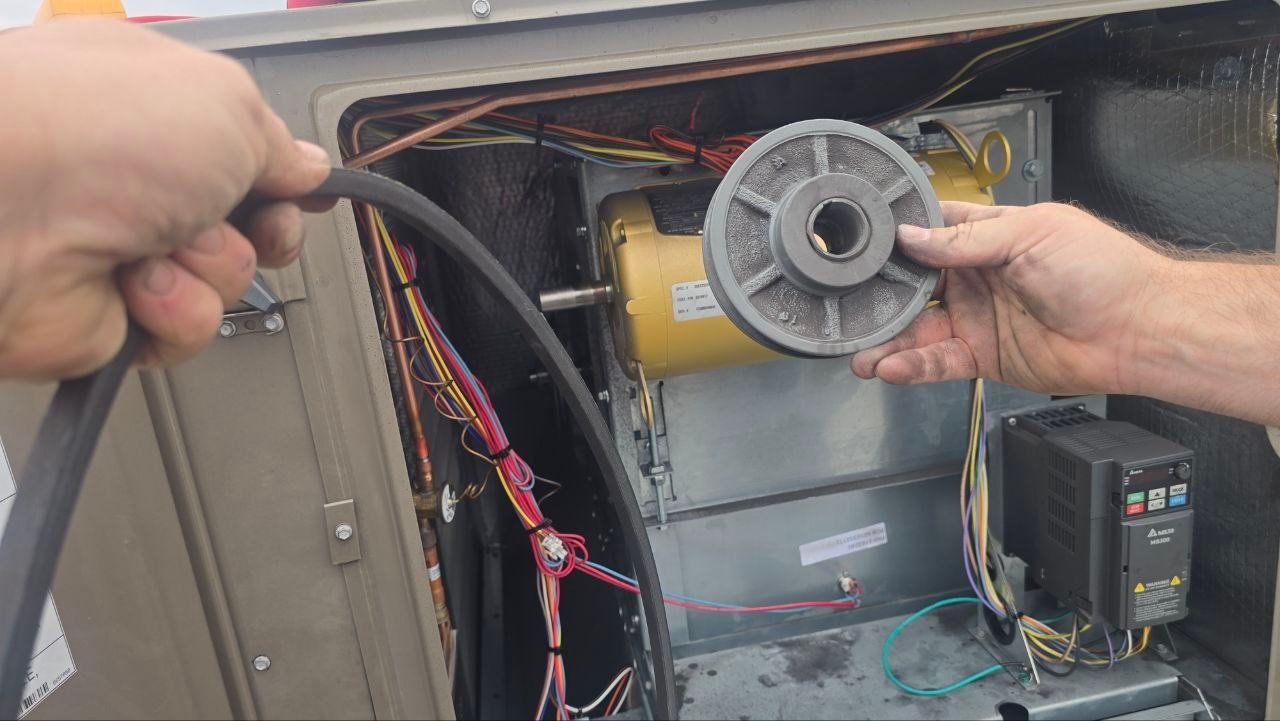
On a furnace built in the last twenty-five years, a high-pitched squeal is almost always a blower motor bearing on its way out. The motor still works and the furnace still heats, but the bearing is telling you it has a season left, not five. On a much older furnace with a belt-driven blower, the belt itself squeals when it is worn or loose, and that is a ten-dollar part. We still see belt-drive furnaces in a few of the 1950s homes around Land Park and Carmichael.
Rattling
Start with the easy answers. Is the access panel seated? Is there a screw missing from the blower door? Is a supply duct in the attic or crawlspace touching a joist? Nine rattles out of ten are one of those. The tenth is a heat exchanger that has cracked or warped and is vibrating against the cabinet as it heats and cools. If the rattle is coming from the furnace itself, changes pitch as the unit warms up, and you cannot find a loose panel, have it looked at. We check the heat exchanger with a camera and take a carbon monoxide reading at the registers on every visit.
Repeated clicking
One or two clicks when the furnace starts is the gas valve and the igniter doing their job. Clicking that goes on for a minute, or clicking with no heat behind it, means the igniter is trying to light and failing, or a relay on the control board is chattering. Either way the furnace is about to stop heating. Our article on a furnace blowing cold air walks through the igniter and flame sensor checks.
Whistling
Air whistles when too much of it is forced through too small a gap. The gap is usually the filter, either clogged or the wrong size and leaving a slot around its edge, or a return grille that was never big enough for the furnace behind it. The second case is standard in the ranch homes around Citrus Heights, Arden-Arcade and Rancho Cordova, where a 1960s return feeds a furnace installed in 2005. The whistle is the symptom. The undersized return is also why the furnace keeps turning on and off, and that is the part worth fixing.
The sounds that are normal
- Popping and ticking in the ducts as they heat and cool. Sheet metal expands. Louder in homes with long metal duct runs in the attic, quieter with flex duct.
- A low hum while the blower runs. A hum that starts suddenly, gets louder, or continues after the blower stops is a capacitor or transformer and worth a look.
- A whoosh when the burners light. That is the sound of ignition working correctly. The problem is the bang, not the whoosh.
- A minute of blower noise after the heat stops. The blower runs on to cool the heat exchanger. Normal on every furnace.
Smells have their own list: our guide to furnace smells covers which ones are normal and which mean leave the house.
Why attic furnaces sound worse
In the tract homes across Natomas, Elk Grove, Roseville and Rocklin the furnace sits in the attic, usually above a bedroom. Every sound it makes travels through the ceiling joists. A rattle that would be background noise in a garage furnace sounds like a problem at two in the morning. Most of the noise complaints we get from attic units turn out to be a loose panel, a duct resting on a joist, or a blower wheel that needs cleaning. Worth knowing before you assume the worst. Also worth knowing: we do not charge extra to go into the attic.
When to call and what it costs
If the sound is a bang at startup, a rumble after shutdown, or scraping metal, turn the furnace off and call today. For a squeal, a rattle you cannot locate, or clicking without heat, call this week. Our diagnostic is a flat $69 across the Sacramento area, credited toward the repair. Same-day service in Roseville, Rocklin, Sacramento, Citrus Heights, Folsom and Elk Grove. In Roseville, see furnace repair in Roseville; in the city, furnace repair in Sacramento. We also have dedicated pages for Rocklin, Folsom, Elk Grove and Citrus Heights. The full page is furnace repair.
If the furnace does nothing at all, no blower and no click, start with our seven checks for a furnace that will not turn on.
Most of the sounds on this list are found and fixed during a fall tune-up: burners cleaned, blower wheel cleaned and tightened, panels seated, igniter tested. If you have not had one in two years, that is the cheaper call.
If the noise turns out to be the heat exchanger, or the furnace is past twenty, our guide to when to replace a furnace lays out the four questions that settle the decision.
If the noise is coming from the outdoor unit in summer rather than the furnace, the sounds mean different things. See AC making a loud noise for which ones mean shut it off now.
Frequently asked questions
Why does my furnace make a loud bang when it turns on?
Delayed ignition. Gas builds up for a second before the burners light and then ignites all at once. It is caused by dirty burners or a weak igniter, and each bang stresses the heat exchanger. Stop using the furnace until the burners have been cleaned and the igniter checked.
Is a rattling furnace dangerous?
Usually not. Most rattles are a loose panel, a missing screw or a duct touching a joist. The exception is a rattle from inside the furnace that changes as it heats up and has no loose panel to explain it, which can be a cracked heat exchanger. Have that checked.
What does a squealing furnace mean?
On modern furnaces, a blower motor bearing wearing out. It will keep working for a while but not for years. On older belt-driven furnaces, a worn or loose belt, which is a cheap part.
Why do my ducts pop when the heat comes on?
Sheet metal expanding as it warms and contracting as it cools. It is normal and louder with long metal duct runs in the attic. It does not need repair.
How much does it cost to fix a noisy furnace?
Our diagnostic is $69 and it comes off the repair. Cleaning burners, tightening a blower wheel or seating a panel are short visits. A blower motor costs more. If the noise turns out to be a cracked heat exchanger, we show you and do not repair it, and we price a replacement instead.