


A furnace blasts hot air and shuts off. A heat pump works differently: it delivers warm air at a lower temperature, so it often runs longer. That makes constant running look like a problem when it is sometimes just how heat pumps work. This guide helps you tell the difference.
When long run times are normal
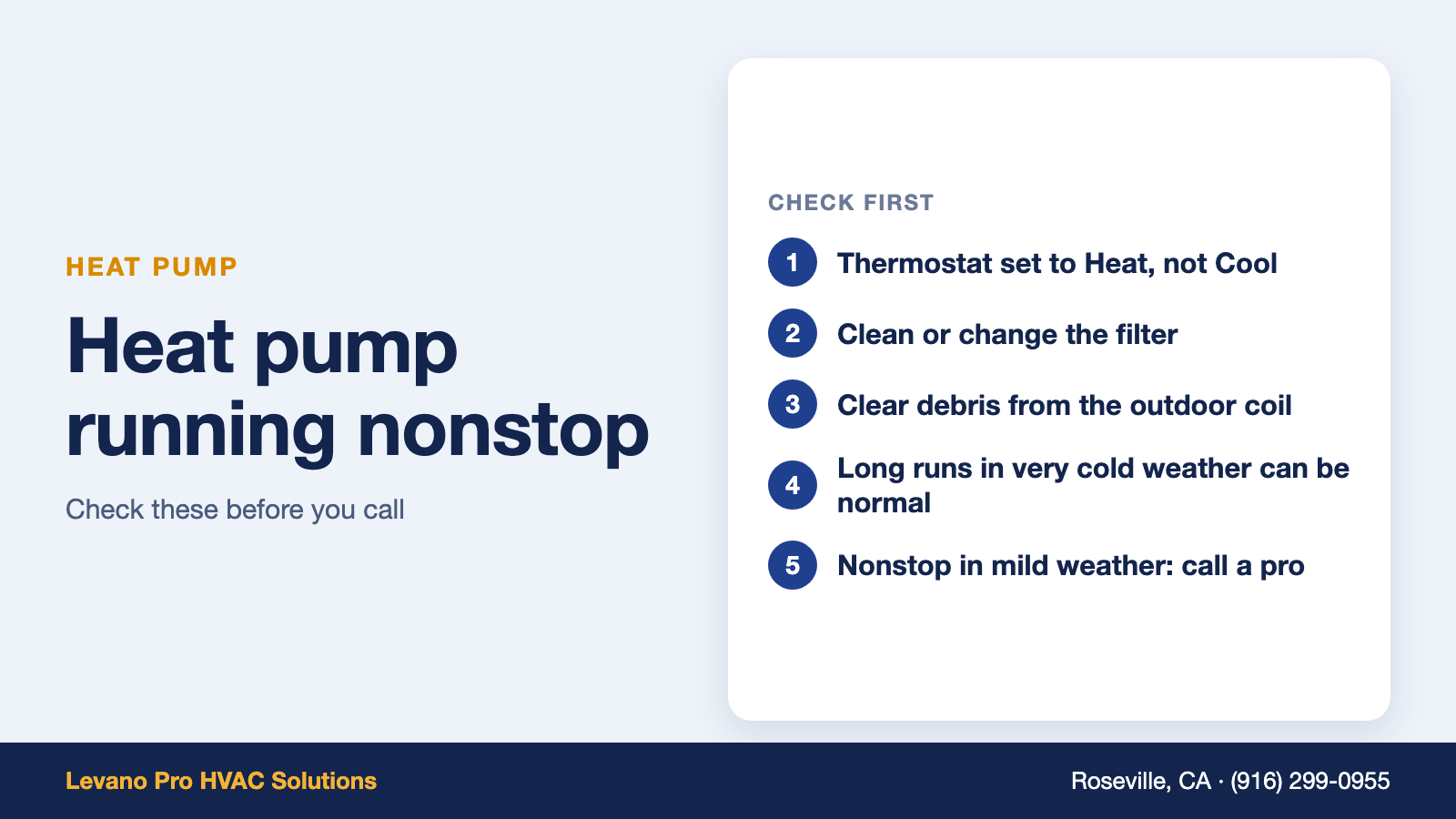
Carrier says constant running can be normal in very cold weather. As the outdoor temperature falls, a heat pump delivers less heat per hour, so it has to run longer to keep up, and the system may also run defrost cycles. Frost on the outdoor coil is normal, and a typical defrost cycle lasts about 5 to 10 minutes according to Carrier. For more on cold-weather operation, see heat pumps below freezing.
Check these first
- Thermostat mode. Confirm it is set to Heat and not Cool.
- Air filter. The Department of Energy advises cleaning or changing heat pump filters once a month or as needed. A clogged filter makes the system run longer and struggle.
- Outdoor coil. Clear leaves and debris from around the outdoor unit. Frost is normal, but a thick layer of ice is not.
- Vents and returns. Make sure furniture or rugs are not blocking airflow.
- Doors and windows. A drafty house loses heat as fast as the system makes it.
Signs of a real problem
- It runs nonstop in mild weather and the house still does not reach the setpoint.
- Ice thicker than about a quarter inch builds up on the outdoor unit. Carrier advises shutting the system off and calling a professional, and warns never to chip the ice.
- The air from the vents feels cool rather than warm for long periods.
- The backup heat runs for long stretches when it is not very cold.
- Your electric bill climbs well above normal.
Carrier lists a frozen coil, a faulty reversing valve, low refrigerant or a compressor problem as likely causes when a heat pump runs nonstop in mild weather. Trane adds that an improperly sized unit or low refrigerant can cause nonstop running. See heat pump not heating and heat pump freezing up.
Auxiliary heat and emergency heat
These are not the same:
- Auxiliary heat is automatic. It turns on when it is too cold for the heat pump alone, after a big thermostat increase, or during defrost.
- Emergency heat is manual. It runs only the backup heat and should be used only if the heat pump has failed.
Backup heat is far more expensive than the heat pump’s normal operation. If you see it running most of the day in mild weather, have the system checked. Manufacturers disagree on exactly how long is too long, so look for a pattern rather than a number.
The thermostat trap
The Department of Energy advises against manually setting back a heat pump thermostat if it causes backup electric heat to come on, because that costs more. If your heat pump seems to run constantly after a big thermostat change, that may be the reason. See our thermostat settings guide and heat pump high electric bill.
Sizing and age
A heat pump that is too small cannot keep up on cold days, and one that is too large cycles on and off. Neither is fixed by adjusting the thermostat. A load calculation shows the right size, and our sizing guide explains how. If your system is old, see heat pump replacement cost.
When to call
Call a technician if the simple checks do not help, if ice builds up, if the backup heat runs for long stretches in mild weather, or if you hear loud noises. See also heat pump short cycling for the opposite problem, and our heat pump repair guide for what repairs cost.
We repair heat pumps in Roseville, Rocklin, Folsom and Elk Grove. Contact us, or read about our heat pump services.
Frequently asked questions
Is it normal for a heat pump to run all day in winter?
In very cold weather, yes. Carrier says constant running can be normal then. A heat pump delivers warm air at a lower temperature than a furnace, so longer cycles are common. If it runs nonstop in mild weather and the house still does not warm up, something is wrong.
Why does my heat pump run constantly and not heat?
Common causes are a frozen outdoor coil, a faulty reversing valve, low refrigerant or a compressor problem, according to Carrier. A dirty filter or a thermostat set to cool can also cause it. Check the simple items first.
What is the difference between auxiliary heat and emergency heat?
Auxiliary heat is automatic and comes on when it is too cold for the heat pump alone, after a large thermostat increase, or during defrost. Emergency heat is manual and runs only the backup heat. Use it only if the heat pump has failed, because it costs much more to run.
Could my heat pump be the wrong size?
Yes. Trane lists an improperly sized unit and low refrigerant among the reasons a heat pump runs nonstop. An undersized system cannot keep up, and an oversized system cycles on and off. A load calculation shows the right size.
Should I set my heat pump thermostat back at night?
Be careful. The Department of Energy advises not setting a heat pump thermostat back manually if it causes backup electric heat to come on. A thermostat built for heat pumps raises the temperature gradually.