


Changing the air filter is the cheapest, most effective maintenance task in a home. It also gets forgotten more than any other. The right schedule depends on the filter, the household and how much the system runs. Here is what the Department of Energy and a major manufacturer recommend.
The basic schedule
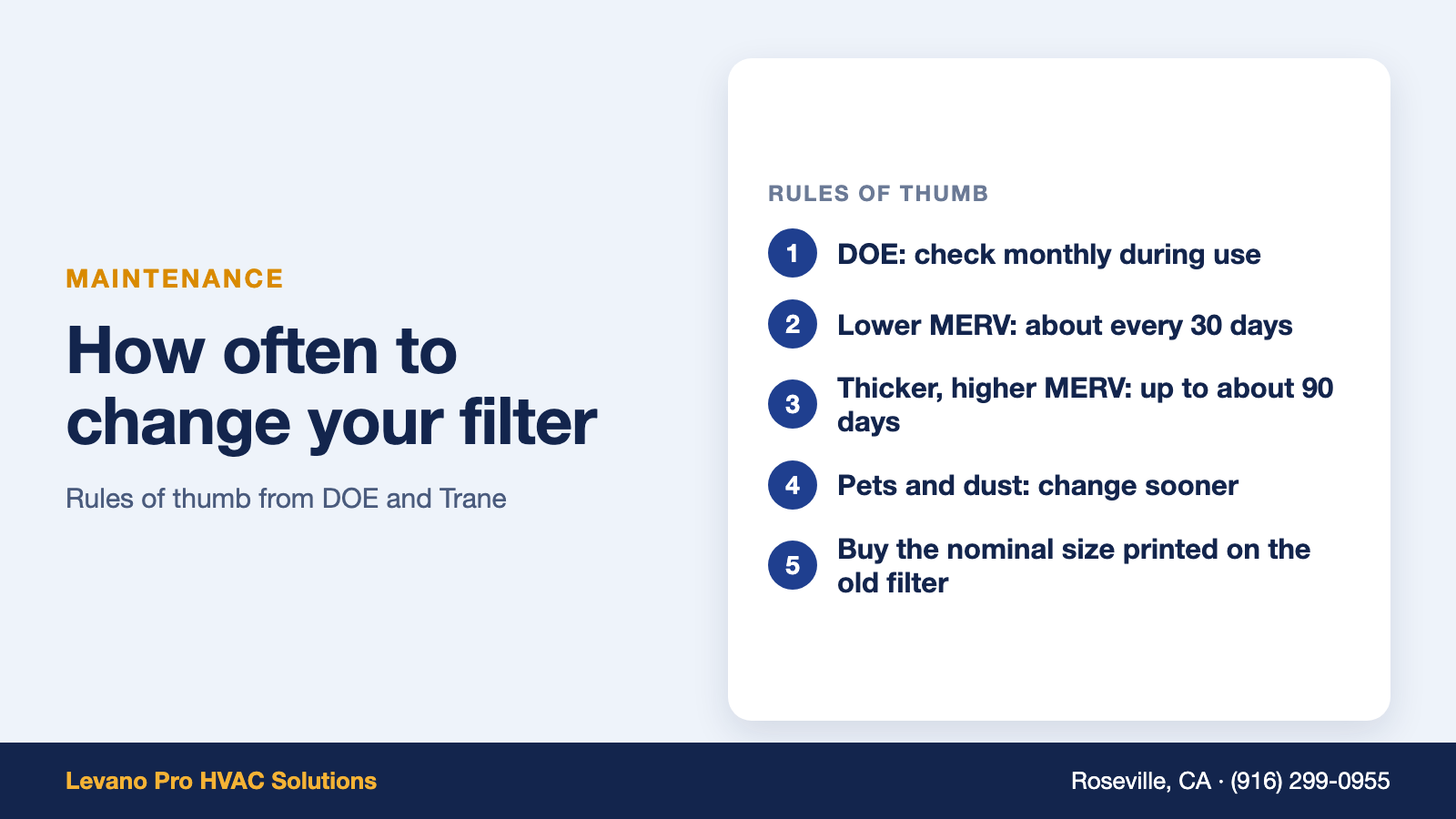
- Department of Energy: clean or replace furnace filters once a month or as recommended, and heat pump filters once a month or as needed.
- Trane, lower-MERV filters: about every 30 days.
- Trane, thicker higher-MERV filters: closer to 90 days.
- Trane, air conditioners: every 30 to 90 days, depending on pets, smokers and allergies.
In practice, check the filter every month and change it when it looks gray and clogged, or sooner in a dusty season. Mark the date on the frame when you change it.
What changes the schedule
- Pets, which add hair and dander
- Smokers and cooking, which add particles
- Construction or remodeling dust
- How many hours the system runs, which is high in Sacramento summers
- Wildfire smoke, which loads a filter quickly. See wildfire smoke and your HVAC filter.
Change filters all year
Trane says to change filters year-round. The blower runs for heating and for cooling, so the filter works in every season. Skipping the summer change is a common way to get a frozen coil. See why is my AC frozen.
How to read the size
The size printed on the filter frame is the nominal size. Trane says the true size is usually about half an inch smaller, so a 16 x 25 x 1 filter measures about 15.5 x 24.5 x 0.7 inches. Buy the nominal size printed on the old filter, and do not measure it with a tape. For a full explanation, see air filter sizes and MERV ratings.
What MERV means
MERV is the Minimum Efficiency Reporting Value. EPA says it covers particles from 0.3 to 10 microns on a scale of 1 to 16:
- MERV 1 to 4: capture less than 20 percent of particles from 3 to 10 microns.
- MERV 8 to 10: also capture particles from 1 to 3 microns.
- MERV 11 to 16: also capture particles from 0.3 to 1 micron.
HEPA filters are a separate category that captures 99.97 percent of 0.3 micron particles, and most homes cannot use one in a standard filter slot. Higher-MERV filters restrict airflow more, so check what your system can handle.
What a dirty filter does
- Restricts airflow, so the system runs longer and uses more energy
- Can make a furnace overheat, according to Trane
- Can contribute to a frozen evaporator coil
- Lets dust build up on coils and in ducts
See furnace will not turn on and air handler leaking water for problems a clogged filter can cause.
Easy habits
- Buy filters in the correct size in packs, and keep them where you can find them.
- Set a monthly reminder, or tie it to the first of the month.
- Write the date on the frame when you install it.
- Check it during heat waves and smoke events.
We include a filter check in every tune-up. See what a tune-up includes or contact us. We serve Roseville, Rocklin, Folsom and Elk Grove.
Frequently asked questions
How often should I change my furnace filter?
The Department of Energy says to clean or replace furnace filters once a month or as recommended. Trane says lower-MERV filters may need changing about every 30 days, while thicker, higher-MERV filters can last closer to 90 days.
Do I need to change the filter in summer too?
Yes. Trane says to change filters year-round, because the blower also runs for the air conditioner or heat pump. A clogged filter in summer can contribute to a frozen coil.
What size filter do I need?
Buy the nominal size printed on the frame of your old filter. Trane notes that the true size is usually about half an inch smaller than the nominal size, so a 16 x 25 x 1 filter measures about 15.5 x 24.5 x 0.7 inches.
What does MERV mean?
MERV stands for Minimum Efficiency Reporting Value. EPA says it rates filters on a scale of 1 to 16 for particles of 0.3 to 10 microns. Higher numbers capture smaller particles. HEPA filters are a separate category that capture 99.97 percent of 0.3 micron particles.
Can a dirty filter damage my system?
Yes. A clogged filter restricts airflow. Trane says it can make a furnace overheat, and dirty filters can contribute to a frozen evaporator coil.