


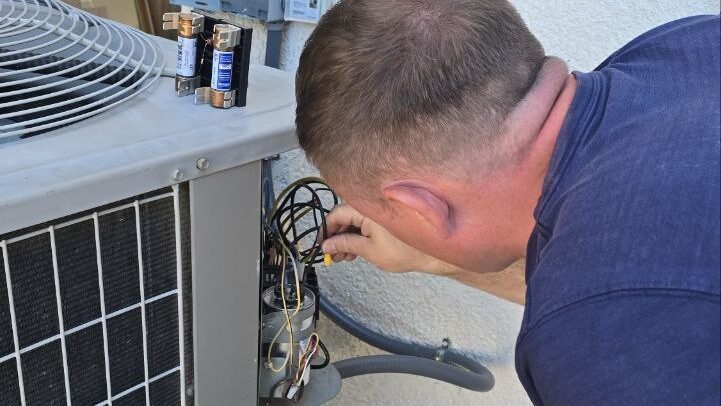
You went outside and the copper line at the condenser is wrapped in ice, or you opened the closet and the indoor coil is a solid block. The system may still be running and blowing air that is barely cool. Here is what to do in the next ten minutes, then why it happened.
Do these two things now
- Turn the cooling off at the thermostat. Not to a warmer setting, off.
- Set the fan to ON. This keeps room-temperature air moving across the coil and thaws it in two to four hours. Leaving the system in cooling makes the ice worse and can send liquid refrigerant back to the compressor, which turns an inexpensive repair into a very expensive one.
Put towels down under the indoor unit. A coil that has been frozen for a day will shed more water than the drain pan is designed to take, and in an attic installation that means a ceiling stain.
Do not chip at the ice. The coil is thin aluminum and copper. A screwdriver or a knife punctures it, and a punctured coil means a refrigerant leak and a repair that costs many times what you were originally facing.
Why it froze
A coil freezes for exactly one underlying reason: it got colder than freezing because not enough heat was reaching it. That happens two ways.
Not enough air moving over the coil
This is the majority of what we see, and most of it is fixable without a technician.
- A clogged filter. The single most common cause. Pull it and hold it to a light.
- Closed or blocked supply registers, or furniture over the return grille. Closing vents to force air upstairs is a common cause of this exact failure.
- A dirty evaporator coil. Dust that got past a cheap or missing filter cakes the coil and blocks airflow through it.
- A failing blower motor or a slipping belt on older equipment.
- Collapsed or crushed return duct. Common in older Carmichael, Arden-Arcade and Citrus Heights homes where the return was undersized from the start.
Not enough refrigerant
A system low on charge runs at lower pressure, which drops the coil temperature below freezing even with normal airflow. Low charge always means a leak, because refrigerant is not consumed. This one needs a technician, and the right fix is finding the leak rather than adding refrigerant and leaving. What that costs is in refrigerant costs and the R-410A phase-out.
Two less common causes
Running the air conditioner when the outdoor temperature is below about 60 degrees will freeze a coil, which catches people out on cool Sacramento evenings in May and October. And a failed metering device, either a TXV or a fixed orifice, will do it at any temperature.
After it thaws
Once the ice is gone, change the filter, open all the registers, and run the system in cooling while you watch it. Then measure: put a thermometer in the return and one in a supply register. A healthy split is roughly 16 to 22 degrees.
- It runs normally and the split is good. Airflow was the problem and you fixed it. Keep an eye on the filter.
- It freezes again within a day. Stop running it in cooling and call. Repeated freezing damages the compressor.
- It runs but the split is low. Likely low on charge, which means a leak.
Why this matters more than it looks
A frozen coil is not a nuisance, it is a compressor risk. Liquid refrigerant returning to a compressor that is built to handle only vapor damages the valves and the bearings. That is the failure that turns into a compressor replacement, which is the most expensive repair in the system. People who run a frozen system through a heat wave because they need some cooling frequently end up replacing the equipment.
What we do
We measure airflow and static pressure, inspect the coil, and verify the refrigerant charge by superheat and subcooling rather than guessing from a gauge. That separates an airflow problem from a leak, and they have very different price tags. Our diagnostic is a flat $69 and it is credited toward the repair.
Related: AC leaking water, AC runs but the house will not cool, and emergency and same-day repair if the house is unsafe in the heat.
Frequently asked questions
How long does it take a frozen AC to thaw?
Two to four hours with the cooling off and the fan set to ON. A coil that has been frozen for a day or more can take longer. Do not speed it up with a hair dryer or hot water, and never chip at the ice.
Can I run my AC while it is frozen?
No. Running it makes the ice worse and risks sending liquid refrigerant back to the compressor, which is the most expensive failure in the system. Turn the cooling off and run the fan only until it thaws.
Why does my AC keep freezing up after I thaw it?
Because the underlying cause is still there. If the filter is clean and all the registers are open and it still freezes, the system is most likely low on refrigerant from a leak, or the evaporator coil is dirty enough to block airflow through it.
Is a frozen AC dangerous?
Not to you, but it is dangerous to the equipment. The risk is compressor damage from liquid refrigerant, and a secondary risk of water damage when a heavily iced coil thaws and overwhelms the drain pan, which matters in attic installations.
Can closing vents cause my AC to freeze?
Yes, and it is a common cause. Closing too many supply registers cuts airflow across the coil enough to drop it below freezing. Close no more than about a third of the total supply area when balancing a house.
Does a frozen AC mean I need more refrigerant?
Not necessarily, and be cautious with anyone who says so without checking airflow first. Restricted airflow causes more frozen coils than low charge does. If the system genuinely is low, it has a leak, and adding refrigerant without finding it is a repair that fails again.