


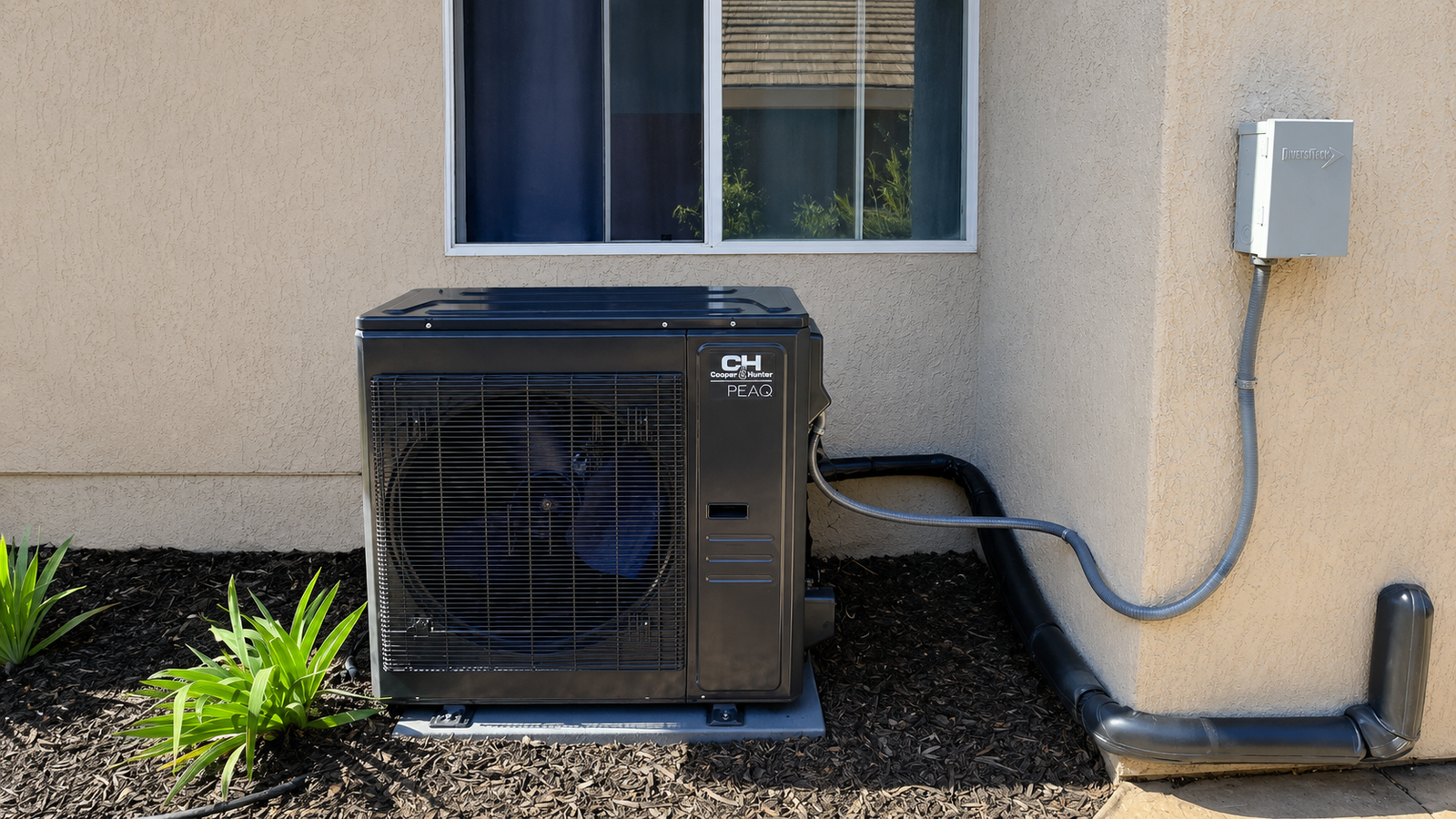
Ductless mini-splits have gone from a niche product to the thing we quote most often for additions, garage conversions and the older Sacramento homes that never had ducts. The question is always the same: what does it cost, and is it cheaper than central air. Here are the real ranges, what moves the number, and the cases where a mini-split is the right answer and the cases where it is not.
The ranges, installed
These are the 2026 national ranges from the cost guides at Angi, HomeGuide and others, and they line up with what we see in the Sacramento area once the specifics below are accounted for.
- Single zone, one outdoor unit and one indoor head serving one room: roughly $1,200 to $5,500 installed. A 12,000 BTU unit for a bedroom sits at the lower half; an 18,000 or 24,000 BTU unit for a large family room at the upper half.
- Two or three zones, one outdoor unit and two or three indoor heads: roughly $4,000 to $9,000.
- Four or five zones, effectively a whole-house ductless system: roughly $7,500 to $14,500.
Labor is typically 30 to 50 percent of the total. The equipment tier, the brand and how hard the line set is to run make up most of the rest.
What moves the price in a Sacramento home
- Line set length and routing. A head on the wall directly behind the outdoor unit is a short run through the wall. A head on the far side of a two-story house means a long line set, a line hide up the exterior wall, and sometimes a trip through the attic. This is the single biggest variable.
- Electrical. Every mini-split needs a dedicated circuit and an outdoor disconnect. If the panel has space, that is a small line item. If the panel is full, which it often is in the 1950s and 60s homes in Arden-Arcade and Citrus Heights, a subpanel or panel upgrade changes the quote materially. In SMUD territory the panel bonus can offset part of that when the mini-split is replacing gas heating.
- Head type. A standard wall-mounted head is the least expensive. Ceiling cassettes, floor-mounted heads and concealed ducted heads cost more and take longer to install.
- Efficiency tier. Most mini-splits are already inverter-driven and efficient. The premium tiers add cold-climate heating capacity that Sacramento rarely needs and quieter indoor heads that some people value.
- Permit and HERS. A mini-split needs a mechanical permit and an electrical permit, and California’s Title 24 requires refrigerant charge verification on new systems. A quote without them is a quote for an unpermitted job.
Where a mini-split wins
- The house has no ducts. Land Park, East Sacramento, Oak Park, the older side of Folsom and Citrus Heights have thousands of homes with a wall heater or floor furnace and window units. Adding ductwork to a 1930s bungalow means tearing into plaster ceilings. Two or three ductless heads heat and cool the whole house without touching them, and in SMUD territory the heat pump rebate applies when the mini-split replaces gas heating.
- One room is the problem. A converted garage, an addition off the back, a bonus room over the garage, a home office that faces west. Extending the central system to reach it usually means an undersized run off an already-stretched duct system. A single-zone mini-split serves the room on its own thermostat and takes the load off the main system.
- The upstairs never cools. In the two-story tracts of Elk Grove, Roseville and Rocklin, a mini-split in the master bedroom is often cheaper than zoning the whole house and lets the main system run less at night.
- Accessory dwelling units. Nearly every ADU in the region ends up with a mini-split, because it is the only sensible way to give a separate unit its own system.
Where central air still wins
- The house already has decent ducts. A four-bedroom two-story home with a working duct system is almost always cheaper to serve with one central heat pump than with five ductless heads, and the central system does not put a unit on every wall.
- You dislike the look. Wall heads are visible. Concealed ducted heads solve that, but at a cost that narrows the gap with central.
- Whole-house filtration matters to you. A central system with a media cabinet filters every room’s air through one MERV 13 filter, which matters during wildfire smoke season. Mini-split heads have their own washable filters, which are fine for dust and less capable against fine smoke.
The rebate side
A mini-split is a heat pump, and in SMUD territory a qualifying ductless system that replaces gas heating can earn the same gas-to-electric rebate as a central heat pump, $2,000 or $3,000 depending on the tier at the time of writing, plus the panel bonus if an upgrade is needed. The equipment has to meet the efficiency tier and be installed through a contractor in SMUD’s network. Roseville Electric has its own smaller program. PG&E territory has statewide programs when funded. The federal 25C credit ended for installations after December 31, 2025. Our guide to SMUD and Roseville Electric rebates lays it out by utility.
What we do
We quote single-zone and multi-zone options side by side, we tell you when a central system would be cheaper, and we include the permit, the electrical and the HERS verification in the number so there is no second invoice. Our ductless mini-split page covers the installation process, and our guide to heat pump brands covers which manufacturers hold up here. Same-day estimates across Sacramento, Roseville, Rocklin, Folsom, Citrus Heights and Elk Grove.
For a range on your own house, the instant estimate calculator includes a ductless option.
Most mini-split problems we get called about come from installation details, especially the condensate drain. See mini-split leaking water inside, and if you are considering a DIY unit, can I install my own mini-split in California.
Frequently asked questions
How much does a single-zone mini-split cost installed?
Roughly $1,200 to $5,500 in the 2026 national cost guides, depending on the BTU size, the head type, the length of the line set and whether a new circuit or panel work is needed. A 12,000 BTU bedroom unit with a short run sits at the low end; a 24,000 BTU family room unit with a long run at the high end.
Is a mini-split cheaper than central air?
For one room, or for a house with no ducts, yes. For a whole house that already has a working duct system, a single central heat pump is usually cheaper than four or five ductless heads.
Do mini-splits qualify for SMUD rebates?
A qualifying ductless heat pump that replaces gas heating can earn SMUD’s gas-to-electric heat pump rebate, currently $2,000 or $3,000 by tier, when installed through a contractor in SMUD’s network. Electric-to-electric replacements earn less. We confirm eligibility on the quote.
Do I need a permit for a mini-split in Sacramento?
Yes. A mechanical permit and an electrical permit, and Title 24 requires refrigerant charge verification on new systems. We include both in the quote.
How long does a mini-split installation take?
A single zone with a short line set is usually half a day. Multi-zone systems, long line runs or panel work take a full day or two.