


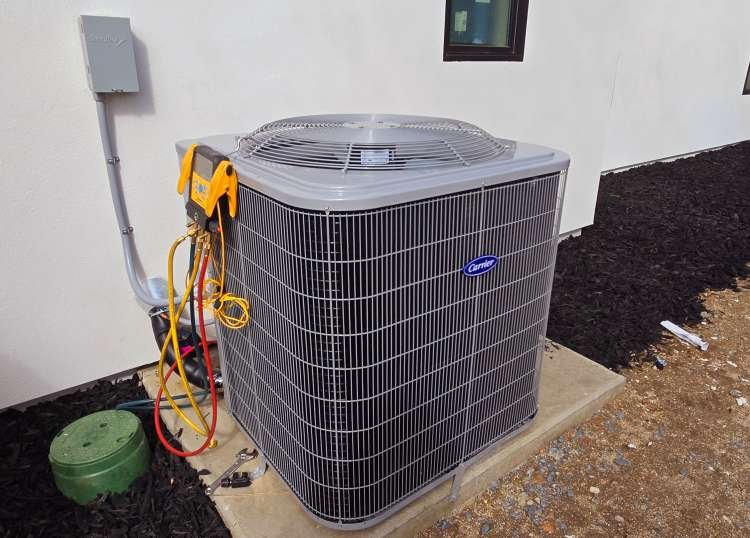
Carrier is the brand people buy when they do not want to think too hard about it, and that is mostly a compliment. It is the safe default: deep dealer network, parts everywhere, a long track record. There is also a quiet way to get the same engineering for less, which we will get to.
A bit of history, because it explains the reputation
Willis Carrier invented modern air conditioning in 1902. The company has been the reference point in the industry ever since, and that is a real advantage in a practical sense: almost every technician knows the platform, and parts are stocked in every supply house. In a July breakdown, “the part is on the shelf” beats a lot of spec-sheet bragging.
The three tiers, plainly
Carrier sells air conditioners in three lines. Ignore the model numbers and think of it as good, better, best.
| Series | Level | Up to SEER2 | Who it is for |
|---|---|---|---|
| Comfort | Base | ~15–16 | Budget replacements, rentals, meeting the California minimum |
| Performance | Mid, often two-stage | ~17–18 | Better comfort without the top-tier price |
| Infinity | Premium, variable-speed | up to 24 | Best efficiency, humidity control and quiet running |
The Infinity 26 reaches up to 24 SEER2 with Greenspeed, Carrier’s variable-speed system that ramps the compressor up and down instead of slamming between full and off. In a long cooling season like ours, that steady modulation is genuinely more comfortable and more efficient than a single-stage unit cycling all afternoon.
The catch with Infinity: it is a communicating system
The top Infinity equipment is what Carrier calls “communicating,” meaning the outdoor unit, indoor unit and thermostat all talk to each other. It works beautifully when everything is matched Carrier gear, and it is the reason those systems control humidity so well.
The trade-off: you are more locked into the Carrier ecosystem, and Greenspeed installs really do want an experienced, authorized installer. A communicating system set up by someone who does not know it will throw faults and frustrate you. So the install matters even more than usual here. Ask who is putting it in before you fall in love with the brochure.
The Bryant trick that saves you money
Here is the thing most people do not know. Bryant is Carrier. Same parent company, Carrier Global, and the same internal components coming down the same lines. The differences are the badge, the dealer program, the sheet metal and the price.
So if you like a Carrier but the Carrier quote comes in high, get a Bryant quote from a good installer. It is not a downgrade, it is the same machine with a less famous name on the grille. We explain the whole who-owns-what picture in our guide to the best HVAC brands, and this is the single most useful thing that map does for your wallet.
The warranty, and a small detail in your favor
Carrier’s Infinity line carries one of the stronger standard warranties on the market: 10 years on parts. The registration window is 90 days from installation, which is actually more forgiving than the 60 days you get with Goodman or Daikin. Still register it the week it goes in, because a warranty you forgot to activate drops to a much shorter base term and we have had to break that news to people more than once.
As always, the warranty covers parts and not labor. Budget for that when you compare quotes.
Reliability and lifespan
Carrier is one of the two brands that consistently lands at the top of owner-satisfaction surveys, alongside Trane. See our Trane air conditioner review for the head-to-head. Built and maintained properly, a Carrier system is expected to run 20 years or more. The equipment is not the weak point.
Worth knowing: in Consumer Reports’ reliability data, one of the standout badges was Day & Night, which is also a Carrier brand. So Carrier engineering shows up at the top of both the satisfaction and the reliability picture, just under different names. We dug into that in our guide to the most reliable AC brands.
What it costs
Carrier is a premium price. Expect to pay roughly 20 to 30% more than a mid-range brand, and a top Infinity system can run north of $15,000 installed. You are paying for the variable-speed comfort, the humidity control and the dealer network. Whether that is worth it depends on how long you are staying and how much you care about the last few degrees of comfort. For where a new system lands generally in this area, see our new HVAC system cost guide.
Who should buy a Carrier
Carrier makes sense if:
- You want the low-regret choice with parts and service available everywhere
- You want top-tier efficiency and the best humidity control
- You are staying in the house long enough for a premium system to pay back
It rewards a long cooling season.
Look at Bryant instead if you like Carrier but want to spend less for the same internals. Look at a value brand like Goodman if the budget is tight and you do not need variable-speed. And compare against Trane, its closest rival, in our best central air conditioner brands guide. See how it stacks up in our side-by-side brand comparison.
The Sacramento angle
Two local notes. The Greenspeed variable-speed technology suits our wide daily temperature swings and the long season, so the efficiency actually pays back here better than in a mild coastal town. And because Infinity is a communicating system, the installer matters more than the badge. We size it with a load calculation, match the components properly, and register the warranty the same day. That is how our installation and replacement quotes are written. If a Carrier you already own is acting up, our repair diagnostic is a flat $69 that goes toward the fix.
Frequently asked questions
Are Carrier air conditioners good?
Yes. Carrier is one of the two most consistent brands for owner satisfaction, with equipment expected to last 20 years or more, top efficiency in the Infinity line, and parts available almost everywhere. The main downside is price.
What are the Carrier air conditioner tiers?
Three lines: Comfort (base, around 15 to 16 SEER2), Performance (mid, often two-stage, around 17 to 18), and Infinity (premium variable-speed, up to 24 SEER2 with Greenspeed).
Are Carrier and Bryant the same?
Effectively yes. Both are owned by Carrier Global and use the same internal components. The differences are branding, dealer network and price, which is why a Bryant quote is worth getting if a Carrier quote is high.
What is Carrier’s warranty?
A 10-year limited parts warranty when you register within 90 days of installation, which is more forgiving than the 60-day window many competitors use. It covers parts, not labor, and drops to a shorter base term if you do not register.
How much does a Carrier air conditioner cost?
Expect about 20 to 30% more than a mid-range brand. A top Infinity system can exceed $15,000 installed. The price buys variable-speed comfort, strong humidity control and a deep service network.