


Nobody wants to call for a quote before they have any idea what the number looks like. So here are real Sacramento-area ranges, what moves them, and how to tell whether the quote in your hand is sane.
If you would rather skip the reading and get a number for your own house, our instant estimate calculator takes about two minutes and applies the rebate for your ZIP code.
Two things worth stating plainly. First, these are current Sacramento market ranges pulled from local 2026 cost guides, not equipment-only prices and not our fixed price list. Second, two identical houses on the same street can land thousands apart depending on ductwork, electrical and access. Any calculator that hands you a firm number without seeing your attic is guessing, including the ones that look official.
The short answer: full replacement in Sacramento
| What you are replacing | Typical installed range (Sacramento, 2026) |
|---|---|
| AC only, reusing good ductwork | $6,000 – $14,000 |
| AC + standard 80% gas furnace, like-for-like | $11,000 – $15,000 |
| High-efficiency AC + 90%+ furnace (two-stage or variable-speed) | $14,000 – $19,000 |
| All-electric heat pump, whole system | $12,000 – $17,000 |
| Large home, major duct work, or a panel upgrade | $18,000 – $25,000+ |
For context, full HVAC replacement across California generally runs $6,500 to $16,000 and higher, above the national average, because of local labor, permits, Title 24 energy rules and climate-zone requirements. Sacramento sits squarely in that picture.
AC-only cost by system size
Tonnage is capacity, not weight: one ton equals 12,000 BTU of cooling. Bigger is not better, and we will get to why. These are AC-only installs on existing ductwork.
| Size | Roughly suits | Typical installed (AC only) |
|---|---|---|
| 2 – 2.5 ton | up to ~1,200 sq ft | $6,000 – $8,500 |
| 3 – 3.5 ton | ~1,200 – 2,000 sq ft | $8,000 – $11,000 |
| 4 – 5 ton or high-efficiency | ~2,000 – 2,800 sq ft | $11,000 – $14,000+ |
Those square-footage figures are a starting point, not a rule. In the Sacramento valley, where systems fight 105-degree afternoons for months, the same house can need different capacity than it would in a mild coastal town. Orientation, glass, insulation and shade all move it, which is why we measure instead of matching the old nameplate.
How much is a new AC unit for a 1,500 sq ft house?
This is the single most common version of the question, so let us answer it directly.
A 1,500 square foot Sacramento home usually lands on a 3 to 3.5 ton system, which puts an AC-only replacement on existing ductwork in the $8,000 to $11,000 range installed. Replacing the furnace at the same time makes it a full system, generally $11,000 to $15,000 for a standard efficiency pairing.
What pushes a 1,500 sq ft house toward the top of those ranges or past them: a west-facing wall of single-pane glass, an attic full of failing duct insulation, an electrical panel with no room, or a jump to high-efficiency variable-speed equipment.
What actually drives your number
- Ductwork. The biggest swing factor. Sealing and repairing existing runs is far cheaper than replacing them, but old, leaking, poorly insulated duct in a 140-degree attic will eat the performance of whatever you buy. Major duct replacement is what pushes a job into that $18,000-plus tier. We check before quoting, and we flag duct work as its own line rather than burying it.
- Efficiency tier. California requires a minimum of 15 SEER2, so that is your floor. Higher-efficiency two-stage and variable-speed equipment costs more and is genuinely worth it in a long cooling season, with a break-even usually around four to seven years, though it will not rescue a badly ducted house.
- Refrigerant transition. New systems now use A2L refrigerants such as R-454B, which run roughly 5 to 10% more than the old R-410A equipment did. Your existing R-410A system remains legal to service and recharge, so nobody should be pressuring you to replace a working unit over this.
- Electrical. Mostly relevant when moving to a heat pump. Some older Sacramento panels lack space for a dedicated 240-volt circuit, and an upgrade is a real add-on cost.
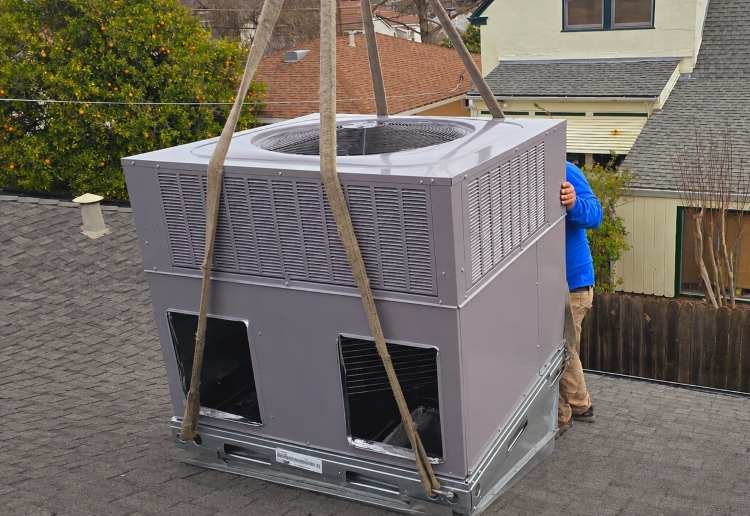
- Access. A furnace in a tight 1920s closet, a rooftop unit needing a crane, a crawlspace you cannot stand in. Labor time is labor cost.
- Permits and Title 24. Replacements require a permit, and California’s Title 24 commissioning adds a few hundred dollars plus permit fees. Anyone skipping it is saving themselves time, not saving you money, and it surfaces when you sell.
Rebates and credits that lower the real cost
Sacramento has a genuine advantage here. SMUD offers some of the strongest heat pump rebates in the state, and a gas-to-electric conversion can be reduced by up to about $3,000. Note that the federal 25C tax credit expired for systems placed in service after December 31, 2025, so 2026 installs no longer qualify. Programs and amounts change, so we confirm what is current at quote time rather than quoting last year’s figures.
Why the cheapest quote often costs the most
When three quotes come back thousands apart, the gap is rarely the equipment. It is what is excluded.
Look for whether the quote names the full matched system rather than just a brand and a tonnage. Ask whether a load calculation was performed or whether they matched the old nameplate. Check whether the permit, Title 24 commissioning, duct work, electrical and haul-away are in the price or waiting to be added later.
Roughly 80% of how long a system lasts comes down to installation quality. A mid-tier unit installed carefully outlives a premium unit installed in a hurry, which means the cheap quote with a great brand name on it is often the worst value on the table.
Should you repair instead?
Sometimes, and we will tell you when. The rough test: if the unit is past about 15 years and facing a repair over roughly a thousand dollars, put the money toward replacement. Under ten years with a common part failure, repair it. A cracked heat exchanger is not a budget decision at any age, it is a carbon monoxide issue.
Our repair diagnostic is a flat $69 and it goes toward the repair, so finding out costs very little.
Ways to bring the number down
Replace in spring or fall rather than during a July heat wave, when everyone is booked and you are deciding under pressure. Register the warranty immediately, since most require it within 60 to 90 days and an unregistered ten-year warranty quietly becomes a shorter one. Use the SMUD rebate and the federal credit if you are going high-efficiency or electric. And spend on duct sealing before spending on efficiency tiers, because it is cheaper and does more.
Getting a real number
An honest quote comes after someone has looked at your attic, your ducts, your panel and your house, and it should be itemized so you can see equipment, labor and extras separately.
The fastest way to start is the HVAC cost calculator: three options with a price range for your address, then a home visit only if you want the exact figure.
That is how our installation and replacement quotes are written. If you are still choosing equipment, our guides to the best central air conditioner brands and the best HVAC brands cover what is actually worth paying for. Our brand comparison puts them side by side. On the heating side, see the best furnace brands. We work across Sacramento, Roseville and the surrounding towns. We install across the region, with dedicated pages for Sacramento, Roseville, Rocklin, Folsom and Elk Grove.
Once you have numbers in hand, how to compare HVAC quotes shows how to line them up so you are comparing the same job. If you are wondering whether you could do part of it yourself, can I replace my own HVAC in California covers what the law and the refrigerant rules allow.
Frequently asked questions
How much does a new HVAC system cost in Sacramento?
A full system replacement, meaning the AC and the furnace together, typically runs $11,000 to $15,000 for a standard-efficiency pairing and $14,000 to $19,000 for high-efficiency equipment. An AC-only replacement on good ductwork is usually $6,000 to $14,000. Larger homes or jobs that need major duct or electrical work can reach $18,000 to $25,000 or more.
How much is a new AC unit for a 1,500 sq ft house?
A 1,500 square foot Sacramento home usually needs a 3 to 3.5 ton system, which puts an AC-only replacement on existing ductwork around $8,000 to $11,000 installed. Replacing the furnace at the same time makes it a full system, generally $11,000 to $15,000. Failing ductwork, difficult access or a jump to variable-speed equipment pushes it higher.
What does a 3 ton AC unit cost installed?
In the Sacramento area, expect roughly $8,000 to $11,000 installed for a 3 to 3.5 ton AC on existing ductwork. Equipment alone is a fraction of that, which is why equipment-only prices found online rarely match real quotes.
Why is HVAC more expensive in California?
Labor, permit costs, Title 24 energy-code commissioning and climate-zone requirements all add up, which is why full replacements here generally run $6,500 to $16,000 and higher rather than the lower national averages. The upside is strong local incentives, including SMUD heat pump rebates.
Does a new system cost more because of the refrigerant change?
Somewhat. Equipment using the new A2L refrigerants such as R-454B runs roughly 5 to 10% more than comparable R-410A equipment did. Your existing R-410A system is still legal to service and recharge, so this is not a reason to replace a working unit.