


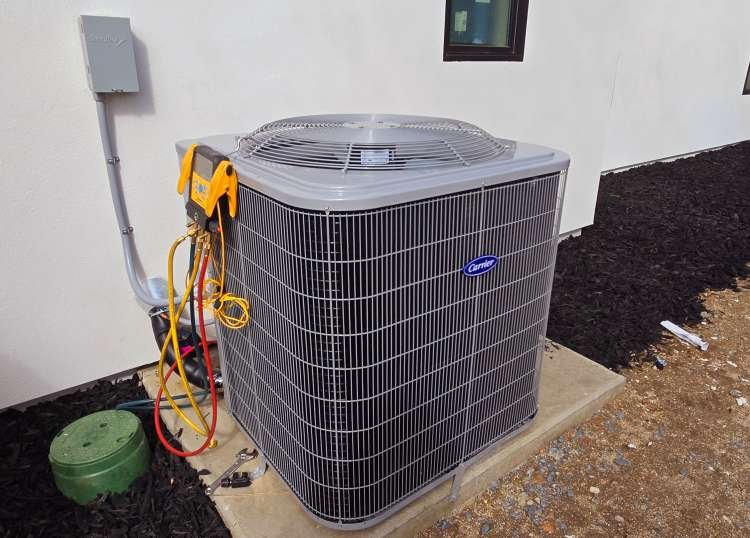
Every brand comparison you find online is either a spec dump or a sales pitch. Here is the version we would give a neighbor: what actually separates these brands, in a table you can read in thirty seconds, then the specific head-to-heads people ask us about most.
One thing to get out of the way first, because it changes how you read the whole table. Several of these “different” brands are the same equipment. Bryant is a Carrier. American Standard is a Trane. (Full American Standard review.) Ruud is a Rheem. Amana is a Goodman. Same factories, same components, different badge and price. It goes further than the badges too: Midea supplies compressors to a large share of the industry, so the same engineering turns up inside brands that compete with each other.
Compare AC brands at a glance
Most people who compare ac unit brands are really trying to answer three questions: how efficient is it, how long will it last, and what happens when it breaks. This table covers all three.
| Brand | Tier | Top SEER2 | Warranty (registered) | Known for | Cheaper twin |
|---|---|---|---|---|---|
| Lennox | Premium | 26 | 10 yr parts | Highest efficiency on the market | — |
| Carrier | Premium | 24 | 10 yr parts + 3 yr labor | Humidity control, deepest dealer network | Bryant |
| Trane | Premium | 22 | 12 yr compressor, 10 yr parts | Durability, best warranty, top reliability record | American Standard |
| Daikin | Premium | 22.5 | 12 yr parts | Inverter tech, R-32, slim FIT cabinet | Goodman |
| Rheem | Mid | 20 | 10 yr parts | Sensible middle, no weak point | Ruud |
| Goodman | Value | 22.5 | 10 yr parts, some lifetime compressor | Cheap, available parts | Amana |
A caveat on the SEER2 column: those are ceiling numbers from each brand’s flagship model. The unit in your actual quote is probably not the flagship, and the rating only applies to a properly matched system. A premium condenser on an old indoor coil does not deliver its rated number.
Trane vs Carrier
The classic matchup, and honestly the closest one. Both are premium, both have deep dealer networks, both last 20 years or more when installed well.
Carrier edges ahead on efficiency (24 vs 22 SEER2) and humidity control, and it is the only one of the two that includes labor coverage, at three years. Trane edges ahead on the warranty that matters longer term, 12 years on the compressor, and on the reliability record, holding a 5 out of 5 from Consumer Reports and twelve straight years as America’s Most Trusted.
Our take: for a Sacramento house running five months a year, we lean Trane on durability. If humidity control and the last couple of efficiency points matter more to you, Carrier. Either way, get a quote for the twin, since Bryant and American Standard cut the price without cutting the engineering. Details in our Trane review and Carrier review.
Carrier vs Goodman
This is really a budget question rather than a brand question, because the gap is wide and both answers are legitimate.
Carrier gives you better efficiency, better humidity control, quieter operation, a stronger dealer network and labor coverage. Goodman gives you a system that costs meaningfully less, with parts that are cheap and stocked everywhere, which matters more than people expect when something fails in July.
Our take: staying in the house ten-plus years and you want to stop thinking about it, Carrier. Staying five to eight years, outfitting a rental, or working to a real budget, Goodman is a rational choice and not a compromise. See the Goodman review for where its entry-level models get weaker.
Goodman vs Rheem
One step apart rather than two. Goodman is the value tier, Rheem is the sensible middle.
Rheem gets you better build quality and a 14 to 18 year expected lifespan for a moderate step up in price. Goodman is cheaper to buy and cheaper to fix, with the tradeoff that entry-level models see repairs a bit more often.
Our take: if the budget stretches, Rheem is the better long-term buy. If it does not, Goodman with a proper install will still serve you well. Both are covered in the Rheem review and Goodman review.
Goodman vs Trane
Opposite ends of the market, so the honest answer is about money rather than merit.
Trane costs roughly double and delivers the strongest warranty, the best reliability record and a longer life. Goodman costs far less and, when installed correctly, still runs 10 to 15 years.
Our take: this comes down to how long you are staying. Long-term home, Trane pays back. Shorter horizon or a rental, the extra money is hard to justify. Worth remembering that roughly 80% of how long any system lasts comes down to the install, not the badge.
Daikin vs Lennox
Two premium brands with genuinely different strengths.
Lennox owns the efficiency crown outright, up to 26 SEER2, the highest available. Daikin leads on inverter technology and moved to R-32 refrigerant ahead of the field, plus the slim FIT cabinet solves tight side-yard installs that a standard condenser cannot fit.
Both share the same practical caveat: parts distribution. Lennox runs parts through its dealer network, and Daikin owners report friction on parts and warranty claims in some regions. With either brand, confirm local service coverage before buying, not after.
Our take: narrow lot or you want the best modulation, Daikin. Chasing the lowest energy bill and there is a solid Lennox dealer nearby, Lennox. See the Daikin review and Lennox review.
Carrier vs Rheem
Premium against mid-tier. Carrier wins on efficiency, humidity control and labor coverage. Rheem wins on price while still giving you a 10-year parts warranty and a 14 to 18 year lifespan.
Our take: Rheem is the better value; Carrier is the better system. Which is correct depends entirely on your budget and how long you are staying.
How to actually compare quotes
Brand is the part everyone argues about and the part that matters least. When you have three quotes side by side, these are the questions that separate them.
- Does the quote name the full matched system? Outdoor unit, indoor coil, air handler or furnace. If it just says a brand and a tonnage, the efficiency number on it means nothing.
- Was a load calculation done? Or did they read the nameplate on the old unit? Oversizing is the most common mistake we find, and it makes a house less comfortable, not more.
- What is excluded? Permit, Title 24 commissioning, duct work, electrical, haul-away. The cheap quote is usually the one hiding these.
- Who registers the warranty? Most require registration within 60 to 90 days. Miss it and your ten-year coverage quietly becomes a much shorter one.
For real installed price ranges in this area, see our new HVAC system cost guide. For the full brand rankings, the best central air conditioner brands guide goes deeper, and the best HVAC brands guide maps out who owns what. Heating buyers should also read our best furnace brands guide. Considering electric heat? See the best heat pump brands.
We install and service every brand on this page across Sacramento and Roseville. If you want a second opinion on a quote you already have, our installation team will tell you straight whether it is fair.
Frequently asked questions
How do you compare air conditioner brands fairly?
Compare the matched system rather than the badge: the SEER2 rating of the specific outdoor and indoor pairing, the warranty terms and registration window, local parts availability, and what the quote excludes. Roughly 80% of a system’s lifespan comes down to installation quality, so the installer matters more than the brand.
Which is better, Trane or Carrier?
They are close. Carrier leads on efficiency at up to 24 SEER2 and includes three years of labor coverage. Trane leads on durability with a 12-year compressor warranty and the strongest third-party reliability record. For a long, hot cooling season we lean Trane.
Is Goodman as good as Carrier or Trane?
No, and it is not priced as if it were. Goodman is a value brand with cheap, widely available parts and a 10 to 15 year typical lifespan. Premium brands last longer and carry better warranties. Goodman is the rational choice on a budget or a shorter time horizon.
Which AC brand has the best warranty?
Trane, with 12 years on the compressor and 10 years on parts when registered. Carrier is the only major that includes labor coverage, at three years. All of them require registration, usually within 60 to 90 days.
Which AC brand is the most efficient?
Lennox, reaching up to 26 SEER2, ahead of Carrier at 24 and Daikin and Goodman around 22.5. Those are flagship-model ceilings, and the rating only holds for a properly matched and correctly installed system.