


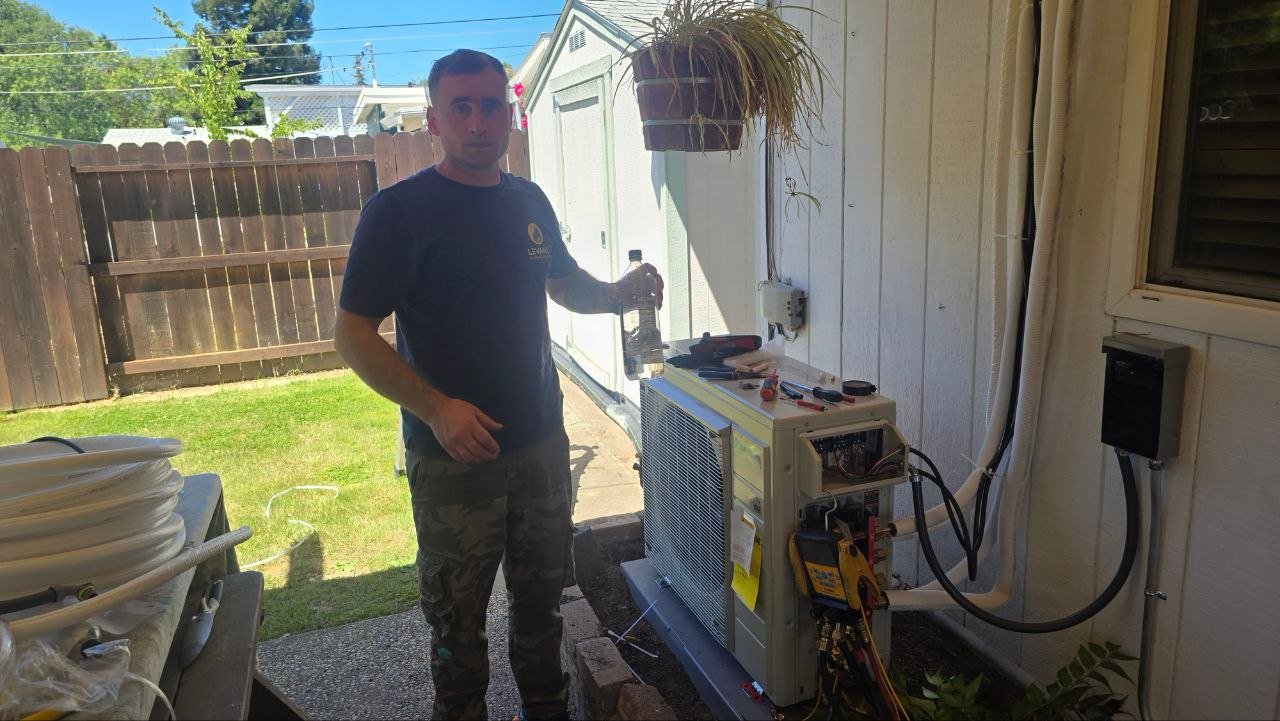
It is 104 outside, the thermostat says 78 and will not budge, and the air coming out of the vents is somewhere between lukewarm and insulting.
Before you call anyone, including us, work through the four checks below. They take about ten minutes and they solve this more often than people expect. If none of them fixes it, the rest of this page tells you what is actually wrong and roughly what it costs to put right.
Four things to check yourself first
- The thermostat is on COOL, not FAN. Sounds patronising. It is the single most common cause we drive out to. On AUTO the blower runs only when the system is cooling. On ON it runs constantly, so between cooling cycles you get room-temperature air blowing on you and it feels broken. Set the fan to AUTO and the mode to COOL, then drop the setpoint five degrees and wait.
- The filter. Pull it out and hold it up to a light. If you cannot see light through it, that is your problem. A blocked filter starves airflow across the evaporator coil, the coil ices over, and iced coils blow warm air. In Sacramento we go through filters faster than the label says, especially in a smoke summer, so the six-month filter often has six weeks of life in it here.
- The breaker. Your system has two circuits, one for the indoor unit and one for the outdoor. If only the outdoor one has tripped, the blower keeps running and pushes uncooled air around the house. Check the panel. Reset it once. If it trips again immediately, stop and call someone, because that is an electrical fault and not a puzzle to keep poking at.
- The outdoor unit. Go outside and look at it. Is the fan spinning? Is it buried in cottonwood fluff, grass clippings or oleander leaves? Two feet of clear space all round, and a coil you can see through. If the fan is not turning at all but you can hear a hum, skip to the capacitor section below, because that is almost certainly what you have. If nothing happens at all, including the indoor blower, see why an AC will not turn on instead.
If all four check out and it is still blowing warm, the problem is inside the machine.
What is actually wrong: the four real faults
A failed capacitor
This is the one we replace most often, by a wide margin. The capacitor is a small cylinder that gives the compressor and fan motor the jolt they need to start. When it weakens, the fan may run while the compressor refuses to start, and you get exactly this symptom: air moving, no cooling.
The tell is a hum from the outdoor unit with a fan that is not spinning, or one that starts if you nudge it. It is a cheap part and a short visit. It is also the reason we push annual maintenance, because a capacitor that is drifting out of spec can be caught in spring instead of failing on the first 105-degree Saturday, when every company in the county is booked out three days.
A frozen evaporator coil
If you find ice on the copper lines or the indoor coil, turn the system off and set the fan to ON to thaw it. Note that a thawing coil overflows the drain pan, which is the usual reason an AC starts leaking water. That takes a few hours. Do not chip at it.
Ice is a symptom, not a cause. Something restricted the airflow or the refrigerant charge is low. If it froze once after a neglected filter, replacing the filter may genuinely be the end of it. If it freezes again within a week or two, you have a real fault and running it that way is how compressors die.
Low refrigerant, which means a leak
Refrigerant is not fuel. It does not get used up. If the charge is low, it leaked, and topping it up without finding the leak means paying for the same repair every summer.
One thing worth knowing in 2026: if your system runs R-410A, that refrigerant is being phased down and the price has been climbing. On a system past about twelve years, a significant leak is often the moment the arithmetic tips toward replacement rather than repair. We will tell you honestly which side of that line you are on, and our guide to how long an air conditioner lasts explains where that line sits.
A failed contactor or compressor
The contactor is the electrical switch that tells the outdoor unit to run. They pit and burn over time and they are inexpensive to replace.
The compressor is the expensive answer. If it has failed outright on a system out of warranty, you are usually looking at replacement rather than repair, because the compressor is most of what the outdoor unit is worth. Our new HVAC system cost guide covers what that runs here.
Why this happens more in Sacramento than the manual assumes
Equipment is rated at 95 degrees. We spend a good part of July and August above that, and a condenser sitting against a west-facing wall in the afternoon is working in conditions well past what it was designed around. Systems that would coast along in a milder place run at their limit here, and parts that are marginal fail under that load rather than quietly getting worse.
Two local specifics we see constantly. Attic-mounted air handlers, which is most of Natomas, Pocket and the newer tracts, sit in a space that passes 130 degrees in summer, so anything electronic up there ages faster. And in a smoke summer, filters load up in weeks rather than months, which is how a perfectly healthy system ends up with a frozen coil in August.
None of that is a reason to panic. It is a reason the spring tune-up earns more here than it does elsewhere.
When to stop troubleshooting and call
Call today if:
- the breaker trips again after you reset it
- you smell burning
- the outdoor unit hums but nothing spins
- there is ice on the lines and it came back after thawing
Those are all faults that get more expensive the longer the system runs.
It can wait until tomorrow if the house is cooling slowly but is cooling, or if it started right after you changed a filter or a thermostat setting.
And genuinely do not call if the fan was simply set to ON. We would rather tell you that on the phone for free than charge you to drive out and flip a switch.
What we do when we get there
Diagnostic is a flat $69, and it goes toward the repair if you have us do the work. That is the whole number, not a trip fee with a diagnostic charge stacked on top of it afterwards.
We check the charge properly rather than guessing, test the capacitor and contactor against spec instead of by eye, measure the temperature split across the coil, and tell you which of the four faults above you actually have. If it is a part, we usually carry it. If it is a compressor on a fifteen-year-old system, we will say so plainly and price both options rather than selling you a repair we do not believe in.
We cover Sacramento, Roseville and the surrounding towns. In Roseville specifically, see our AC repair page; in the city, AC repair in Sacramento; in Rocklin, the same $69 and a ten-minute drive from our shop; Folsom, Citrus Heights and Elk Grove too. Full details on our AC repair page, or call (916) 299-0955.
Wondering about the bill before you call? Our guide to what AC repairs cost in Sacramento lists the common repairs with real ranges and how to read an estimate.
If the air is cool but the house still will not come down on a hot afternoon, that is a different problem and it is covered in AC runs all day and the house still will not cool. If you find ice on the refrigerant line, start with why your AC is frozen instead.
Frequently asked questions
Why is my AC blowing warm air?
Most often the thermostat fan is set to ON instead of AUTO, the filter is blocked, the outdoor breaker has tripped, or the outdoor unit is blocked. If those check out, the usual faults are a failed capacitor, a frozen evaporator coil, low refrigerant from a leak, or a failed contactor or compressor.
Why is my AC running but not cooling the house?
The blower and the compressor are separate. If the blower runs and the compressor does not, air still moves through the vents but nothing removes heat from it. A failed capacitor is the most common reason for that exact combination, and the tell is a hum from the outdoor unit with a fan that will not spin.
Can I fix an AC blowing warm air myself?
Sometimes. Setting the fan to AUTO, replacing a clogged filter, resetting a tripped breaker once and clearing debris from the outdoor unit are all safe and they solve this frequently. Anything involving refrigerant, capacitors or wiring needs a technician, and a breaker that trips twice is an electrical fault rather than a nuisance.
Should I add refrigerant to my air conditioner?
No. Refrigerant is not consumed, so a low charge means there is a leak. Topping it up without repairing the leak means paying again next season, and with R-410A being phased down the cost of doing that keeps rising.
How much does it cost to find out what is wrong?
Our diagnostic is a flat $69 across Sacramento and Roseville, and it goes toward the repair if we do the work.